
How to Navigate Government Relations for Nonprofits

Government relations for nonprofits is defined as the organized practice of engaging legislative, regulatory, and executive bodies to advance an organization’s mission through legal advocacy, lobbying, and policy influence. Most nonprofit leaders treat this work as a compliance burden rather than a strategic asset, and that framing costs them real influence. The standard industry term for this discipline is public affairs, and mastering it requires understanding three interlocking systems: federal lobbying law under IRC § 501©(3), state registration requirements, and the relationship-building tactics that convert policy goals into legislative outcomes. This guide covers all three with the specificity you need to act.
What are the federal lobbying rules nonprofits must understand?
501©(3) nonprofits operate under one of two federal lobbying frameworks: the “substantial part” test or the 501(h) expenditure test. The substantial part test is deliberately vague. It prohibits a “substantial” portion of activities from being lobbying, but the IRS has never defined a precise dollar threshold. That ambiguity creates real legal exposure for organizations without disciplined tracking.
The 501(h) election, filed via IRS Form 5768, replaces that ambiguity with dollar-based ceilings. Under 501(h), a nonprofit with $400,000 in exempt-purpose expenditures may spend up to $80,000 on lobbying. An organization spending $2,000,000 may spend up to $250,000. The absolute cap is $1,000,000 regardless of organizational size. This sliding scale makes budget planning tractable, which is why most legal advisors recommend the 501(h) election for any organization with active advocacy goals.

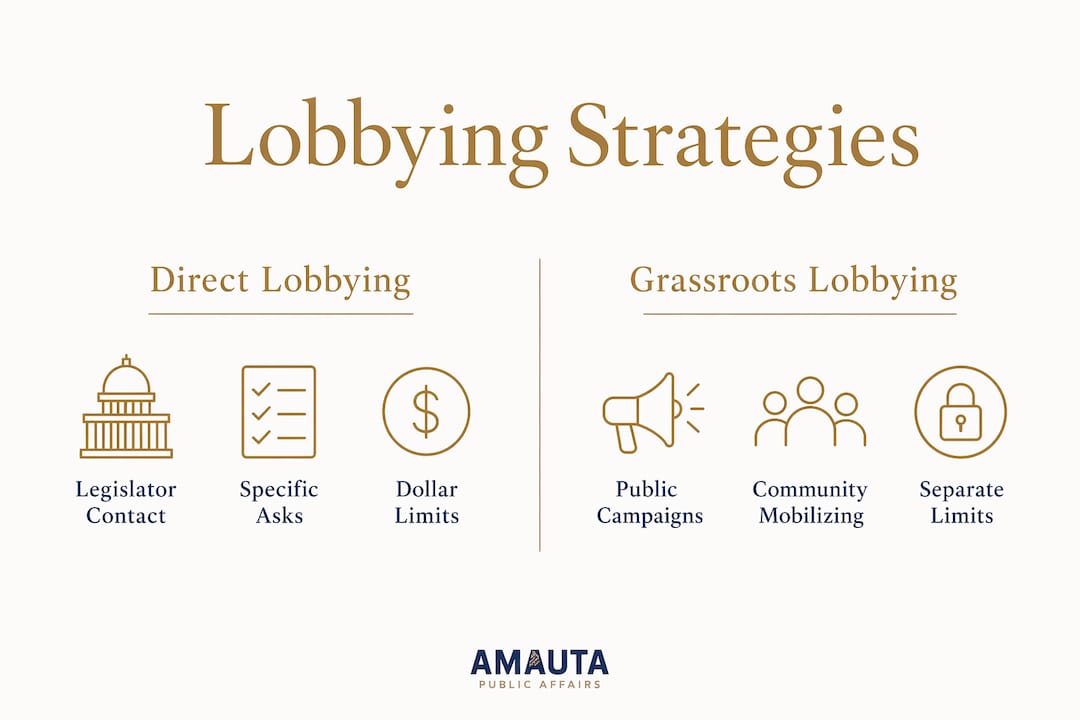
Direct lobbying and grassroots lobbying carry separate sub-limits under 501(h). Direct lobbying targets legislators or their staff with a specific legislative ask. Grassroots lobbying asks the public to contact legislators. Grassroots expenditures cannot exceed 25% of the total lobbying limit. If your total lobbying ceiling is $200,000, your grassroots cap is $50,000. Exceeding either sub-limit triggers a 25% excise tax on the excess amount, and repeated violations can cost an organization its tax-exempt status.
Framework | Threshold | Penalty for excess |
Substantial part test | Undefined; IRS discretion | Loss of 501©(3) status |
501(h) expenditure test | Up to 20% of first $500K; $1M cap | 25% excise tax on excess |
Grassroots sub-limit | 25% of total lobbying limit | 25% excise tax on excess |
Pro Tip: File IRS Form 5768 at the start of your fiscal year. The election takes effect for the entire year it is filed, so late filing means operating under the substantial part test for months you cannot recover.
How can nonprofits strategically engage policymakers?
Effective government relations for nonprofits begins with a clear organizational mission statement that frames every policy ask. Policymakers receive hundreds of requests each session. The ones that land are specific, tied to constituent impact, and supported by both data and human narrative. A housing nonprofit asking for increased Section 8 voucher funding is more persuasive when it pairs census data on local housing cost burden with a tenant’s documented experience.
Aligning your message with government priorities is not compromise. It is precision. When a city council is focused on economic development, a workforce nonprofit frames its job training program as an economic asset, not a social service. That reframing does not change the program. It changes who listens.
Building influence requires a structured approach. Here is a proven sequence for nonprofit advocacy engagement:
Clarify your ask. Define one to three specific, measurable policy outcomes before any outreach begins. Vague requests produce vague responses.
Map power structures. Identify decision-makers and their committee roles, staff contacts, and known priorities. Focus effort where influence actually resides, not where titles suggest it should.
Build coalitions. Align with organizations that share your policy goal, even if their missions differ. A coalition of five organizations representing 50,000 constituents carries more weight than a single voice.
Request meetings with lead time. Meeting requests in Washington, D.C. require four to six weeks of advance notice. Use the Capitol Switchboard at 202-224-3121 and direct outreach to legislative aides, who often control scheduling.
Follow up in writing. A concise email summarizing your ask within 48 hours of any meeting reinforces your message and creates a paper trail for staff briefings.
Pro Tip: Do not wait for a bill to drop before making contact. Relationships built during off-session periods are far more durable than those formed under legislative deadline pressure.
Many nonprofits begin with low-commitment actions like signing coalition letters, attending public hearings, and distributing legislative alerts before scaling to direct lobbying. This graduated approach builds internal capacity and staff confidence without overextending resources. It also creates a documented record of engagement that strengthens credibility with policymakers over time.
What compliance requirements apply at the state level?
Federal tax compliance under 501(h) does not satisfy state lobbying registration obligations. These are parallel, separate systems with distinct triggers, fees, and reporting schedules. Federal compliance does not exempt nonprofits from state requirements, and assuming otherwise is one of the most common and costly mistakes in nonprofit public affairs.
State registration requirements vary significantly. Illinois, for example, requires a $300 registration fee per registrant and bi-monthly reporting for compensated lobbyists. Some states require registration based on time thresholds rather than dollar amounts. Others trigger registration the moment a paid staff member contacts a legislator on a policy matter, regardless of expenditure level.
Key compliance considerations for multi-state advocacy include:
Registration triggers differ by state. Some states define lobbying by compensation paid; others define it by time spent or contact made. Verify each state’s specific definition before any cross-jurisdictional outreach.
Reporting frequency varies. Some states require monthly reports; others require quarterly or bi-annual filings. Missing a reporting deadline carries fines even when the underlying activity was compliant.
Coalition participation creates exposure. If your organization joins a multi-state coalition and a coalition partner registers as a lobbyist in a state where you have not registered, your participation may independently trigger registration requirements.
Recordkeeping must be granular. Track staff time by activity type, not just by project. A timesheet that distinguishes between “policy research,” “direct legislator contact,” and “grassroots mobilization” is the prerequisite for accurate reporting.
State | Registration fee | Reporting frequency |
Illinois | $300 per registrant | Bi-monthly |
California | Varies by activity | Quarterly |
New York | Varies by expenditure | Semi-annual |
Texas | $150 per registrant | Monthly during session |
Early engagement with a state-level compliance attorney is not a luxury for organizations operating across multiple jurisdictions. It is a cost-control measure. Retroactive registration and penalty payments consistently exceed the cost of proactive legal consultation.
Which tools and mistakes define success or failure in government relations?
Accurate tracking of direct versus grassroots lobbying expenditures is the operational foundation of compliant advocacy. Without it, organizations operating under 501(h) cannot confirm they are within sub-limits until it is too late to adjust. The tracking system does not need to be sophisticated. A shared spreadsheet with columns for date, staff member, activity type, time spent, and dollar cost is sufficient for most organizations with moderate advocacy programs.
Common mistakes that undermine nonprofit government relations efforts:
Conflating advocacy with lobbying. Advocacy includes all efforts to educate the public and policymakers about an issue. Lobbying is the specific subset that involves a direct call to action on legislation. Only lobbying counts against your expenditure limits.
Overstating lobbying activity relative to mission. The IRS evaluates whether lobbying is a substantial part of overall activities. Organizations that frame routine program work as advocacy without documentation create unnecessary audit risk.
Failing to register in states where coalition partners are active.
Treating government relations as a campaign rather than an ongoing relationship. One meeting with a legislator is a conversation. Consistent, credible engagement over multiple sessions is influence.
A step-by-step approach to building government relations capacity looks like this:
Educate staff and board. The Minnesota Council of Nonprofits recommends starting with internal education on what your organization can and cannot do under 501©(3) before any external engagement.
File IRS Form 5768 if you have not already. This single action converts your lobbying framework from vague to measurable.
Implement a tracking system. Separate timesheets or activity logs for direct and grassroots lobbying are non-negotiable for 501(h) compliance.
Audit state registration requirements in every state where you plan to contact legislators or mobilize constituents.
Develop a policy advocacy campaign with defined goals, a timeline, and assigned staff roles before the legislative session begins.
Pro Tip: Assign one staff member as your compliance lead for government relations. This person owns the tracking system, monitors expenditure limits, and flags state registration deadlines. Distributed responsibility for compliance is functionally no responsibility at all.
Key takeaways
Nonprofits that treat government relations as a structured discipline, not a reactive obligation, consistently outperform those that engage sporadically and without legal grounding.
Point | Details |
File IRS Form 5768 | The 501(h) election replaces vague lobbying limits with clear dollar-based ceilings. |
Track direct vs. grassroots separately | Grassroots lobbying cannot exceed 25% of your total lobbying limit under 501(h). |
State compliance is a separate track | Federal 501(h) compliance does not satisfy state registration or reporting requirements. |
Build relationships before sessions | Policymaker relationships formed outside of legislative deadlines produce more durable influence. |
Start small and scale deliberately | Coalition letters and public hearings build capacity before committing to direct lobbying. |
What I have learned about nonprofit government relations that most guides miss
Most articles on this topic treat government relations as a legal compliance problem with a strategic layer on top. After years of working with organizations across sectors, I have come to see it the other way around. The legal framework is the floor, not the ceiling. What determines whether a nonprofit actually moves policy is the quality of its relationships and the consistency of its presence.
The organizations that struggle most are those that engage government only when they need something. They show up during budget season, make their ask, and disappear. Policymakers and their staff notice this pattern, and it erodes credibility faster than any compliance misstep. The organizations that win are the ones whose names come up in staff briefings because they have been reliable sources of data, constituent perspective, and honest feedback for years.
I also think the sector underestimates how much state-level compliance work is genuinely complex. The variation across jurisdictions is not a bureaucratic inconvenience. It reflects fundamentally different definitions of what lobbying is. An organization that is fully compliant in California may be in violation in Texas doing the exact same activity. That is not a hypothetical. It is a pattern I have seen repeatedly, and it is entirely preventable with early legal consultation and granular tracking.
The pathway to sustainable government relations is not insider access. It is mission clarity, consistent presence, and the operational discipline to stay compliant while you build. That combination is available to any nonprofit willing to invest in it.
— Ignacio
How Amautapublicaffairs supports your government relations strategy
Amautapublicaffairs brings a campaign-style approach to nonprofit public affairs, combining compliance expertise with the kind of community engagement and strategic messaging that moves policy. Whether your organization is filing its first IRS Form 5768 or managing a multi-state advocacy coalition, the firm’s tailored services cover stakeholder mapping, direct outreach strategy, and real-time feedback systems that keep your program on track.
The team at Amautapublicaffairs evaluates your organization’s specific policy goals, community context, and compliance obligations before recommending a course of action. No two advocacy programs look the same, and the firm’s process reflects that. If you are ready to build a government relations program that produces measurable results, connect with the team to start the conversation. You can also review the full range of advocacy services available to nonprofit clients.
FAQ
What is the 501(h) election for nonprofits?
The 501(h) election, filed via IRS Form 5768, replaces the vague “substantial part” lobbying test with clear dollar-based expenditure limits. It allows nonprofits to spend up to 20% of their first $500,000 in exempt-purpose expenditures on lobbying, with an absolute cap of $1,000,000.
What is the difference between direct and grassroots lobbying?
Direct lobbying involves contacting legislators or their staff with a specific legislative ask. Grassroots lobbying asks the public to contact legislators. Under 501(h), grassroots expenditures cannot exceed 25% of the total lobbying limit.
Do state lobbying registration rules apply separately from federal rules?
Yes. State lobbying registration and reporting requirements are entirely separate from federal 501(h) compliance. States like Illinois require a $300 registration fee and bi-monthly reporting for compensated lobbyists, regardless of federal filing status.
How should nonprofits track lobbying expenditures?
Nonprofits should maintain separate activity logs or timesheets that distinguish direct lobbying from grassroots lobbying, recording date, staff member, activity type, time spent, and associated costs. This granular tracking is the prerequisite for accurate 501(h) reporting.
When should a nonprofit start building government relationships?
Relationship-building with policymakers should begin well before any legislative session. Consistent, off-season engagement produces more durable influence than contact made only when a specific bill is under consideration.
Recommended
Comments