
Developers: Protect Permits With Liaison Led Noise Complaint Response

A strategic noise complaint response pairs rapid acknowledgement and short-term mitigation with targeted stakeholder outreach, enforceable contract controls, and transparent report-backs, all led by a named project liaison. The immediate objectives are simple: contain escalation, protect the permitting schedule, and document every action taken. Public-affairs staff or a senior project manager should own this process from the first phone call, not legal counsel reacting after a complaint reaches a regulator.
TL;DR:
Respond to noise complaints within one business day, logging all details and assigning a dedicated liaison and technical lead immediately.
Use a hierarchy of mitigation measures at the source, path, and receiver levels, ensuring contractors are contractually obligated to implement solutions.
Engage affected communities with ongoing, multilingual outreach through virtual and in-person events, updating boundaries as new concerns emerge.
Maintain a detailed complaints register with supporting evidence, escalation thresholds, and clear ownership to prevent complaints from reaching regulators.
Communicate transparently with the public through consistent updates, community summaries, and personal responses to foster trust and prevent escalation.
Table of Contents
What Are the First Steps in a Noise Complaint Response?
The first 48 to 72 hours determine whether a single complaint stays isolated or becomes a pattern that regulators notice. Speed and documentation matter more than a perfect fix in this window.
Acknowledge within one business day. A voicemail, email, or text confirming receipt signals the project is listening, even before a resolution exists.
Log every detail. Date, time, location, noise source, weather, and the complainant’s stated impact all belong in the record.
Assign a liaison and a technical lead. One name handles communication; one engineer or acoustical specialist evaluates the cause.
Deploy short-term mitigation fast. Shift equipment schedules, swap in quieter machinery, or add temporary shielding while a permanent fix is assessed.
Evidence collection runs parallel to outreach. Time-stamped sound-level readings, equipment logs, and photos of any temporary barriers all strengthen your position if the complaint escalates to a regulatory review.
Keep a running complaints register with a unique case number for each entry.
Attach supporting evidence (readings, photos, correspondence) directly to that case file.
Note the resolution date and method for every closed complaint.
Pro Tip: Assign the liaison’s direct phone number, not a general hotline, to the first three complainants from any single location. A recognizable human voice de-escalates faster than an automated queue.
Who Are the Affected Stakeholders, and How Do You Reach Them?
Affected-community boundaries aren’t fixed at the permitting stage. They shift as engagement reveals who is actually hearing the noise, and infrastructure owners should update those boundaries continuously based on what they learn from residents, not just initial modeling. The FMSIB toolkit on integrating community considerations recommends capturing input at a thematic level so patterns in concern, not just individual complaints, drive mitigation decisions.
Reaching the right people takes more than a single mailer:
Hold after-hours events for residents who work standard daytime shifts.
Mix virtual and in-person formats so mobility or scheduling never becomes a barrier to participation.
Translate materials for multilingual neighborhoods rather than assuming English suffices.
Partner with existing community organizations that already hold local trust.
Some jurisdictions require documented public involvement before certain noise abatement measures move forward, including formal polling of benefitted receptors under policies like WSDOT’s noise procedure. When polling applies, treat the process as evidence, not formality. A defensible outreach record is worth more during a permitting challenge than any verbal assurance of community support.
What Mitigation Options Belong in Your Construction Contract?
Noise control follows a hierarchy: fix it at the source, block or redirect its path, or shield the receiver. Source-level fixes, such as choosing electric equipment over diesel, cost more upfront but eliminate problems before they start. Path-level measures, such as temporary noise barriers or rerouted haul roads, address noise once it’s already generated. Receiver-level fixes, like offering temporary relocation to the most affected residents, are the last resort for the hardest cases.
The FHWA Construction Noise Handbook lays out how this hierarchy should shape actual contract language, not just design intent. Mitigation only works if contractors are obligated to deliver it.
Mitigation Level | Example Measure | Contract Mechanism |
Source | Equipment selection, low-noise machinery | Bid specification requirement |
Path | Temporary barriers, haul route changes | Performance clause with monitoring |
Receiver | Insulation, temporary relocation | Triggered by threshold exceedance |
Effective contracts include:
Incentive and disincentive clauses tied to measured noise levels, not just good-faith effort.
Mandatory contractor training on approved equipment and permitted work hours.
A monitoring and enforcement program with defined remedies for repeat violations.
A dispute resolution path that doesn’t require litigation for routine disagreements.
Bring in an acoustical consultant early, not after complaints start piling up. The I-INCE guidance on community noise impact assessment recommends a staged approach where technical support and stakeholder input shape mitigation options together, rather than technical fixes getting bolted on after community pushback. For larger infrastructure work, a project-specific code of construction practice, similar in structure to the UK’s Section 61 consent process, gives contractors and regulators a shared reference for core hours, thresholds, and complaint procedures. Where insulation or property acquisition enters the conversation, VDOT’s noise policy manual makes clear that coordination with state or federal authorities becomes necessary, not optional.
How Should You Communicate With Complainants and the Public?
Consistency beats charisma. A community that gets the same information through the same channels on a predictable schedule trusts a project far more than one that only hears from it when something goes wrong.
Publish a hotline number and staff it during active construction hours, not just business hours.
Post site notices at the property line with the liaison’s name and contact information visible from the sidewalk.
Send a monthly newsletter summarizing complaint volume, resolution rates, and upcoming schedule changes.
Update a project webpage with the same information, so residents can check status without calling.
Hold public meetings at milestones, not just when a crisis demands one.
Coordinate messaging with local officials and regulators before, not after, you send anything to residents. A city council member blindsided by a community newsletter becomes an adversary fast. Amautapublicaffairs frequently builds this coordination directly into stakeholder communication strategies, aligning what the project says publicly with what regulators already know.
Pro Tip: Report noise complaint volume even when the number is zero. Silence reads as evasion; a monthly “no new complaints this period” line builds more credibility than no report at all.
How Do You Track and Escalate Noise Complaints?
An auditable complaints register needs a minimum set of fields: case number, date and time, location, noise source, complainant contact (with consent to log it), initial mitigation applied, resolution date, and attached evidence such as sound readings or photos.
Monitoring strategy depends on risk level. Spot checks work for low-frequency, low-severity activity. Continuous monitoring, using fixed sound-level meters logging around the clock, makes sense near hospitals, schools, or repeat-complaint zones.
Escalation needs clear thresholds and named owners:
A single complaint from a new location triggers a liaison call within 24 hours.
Three or more complaints from the same area within a week trigger a technical review by the acoustical lead.
Any exceedance of a permitted decibel threshold triggers contractor notification and a documented corrective action.
Regulatory referral happens only after internal mitigation has been attempted and logged.
How Do You Close the Loop With the Community?
Reporting back matters as much as the fix itself. Transparency about what was heard and what changed is central to preserving a project’s credibility with the people living next to it.
An effective report-back covers four things: what the community said, what actions the project took, what monitoring data showed afterward, and what happens next if the problem recurs.
Respond to individual complainants directly within the timeframe promised at intake.
Publish a community-wide summary quarterly, even for complaints already resolved individually.
Archive every case file so mitigation decisions have a paper trail during permitting renewals or expansions.
Feed recurring complaint patterns back into design and contract specifications for future project phases.
Report-Back Element | Audience | Typical Timing |
Individual response | Complainant | Within 5 business days |
Community summary | Broader neighborhood | Quarterly |
Lessons-learned memo | Internal design/contract team | End of construction phase |
What Actually Drives Complaints to Escalate?
The escalation pattern I’ve seen most often has nothing to do with decibel levels. It’s the absence of a named liaison. Residents don’t file a second complaint because the noise got worse; they file it because nobody called them back after the first one. A slow acknowledgement reads as indifference, and any hint that a project is withholding information about mitigation plans reads as bad faith, even when the real explanation is bureaucratic delay.
The fix is a short checklist, not a long theory: confirm a liaison is assigned and reachable, review the construction schedule for immediate adjustment options, document the mitigation actions taken, set a monitoring plan with defined thresholds, and commit to a report-back date before the complainant has to ask for one. Projects that run this sequence every time rarely see complaints reach a regulator’s desk. Projects that skip the liaison step almost always do.
— Ignacio
How Amautapublicaffairs Supports Your Response Plan
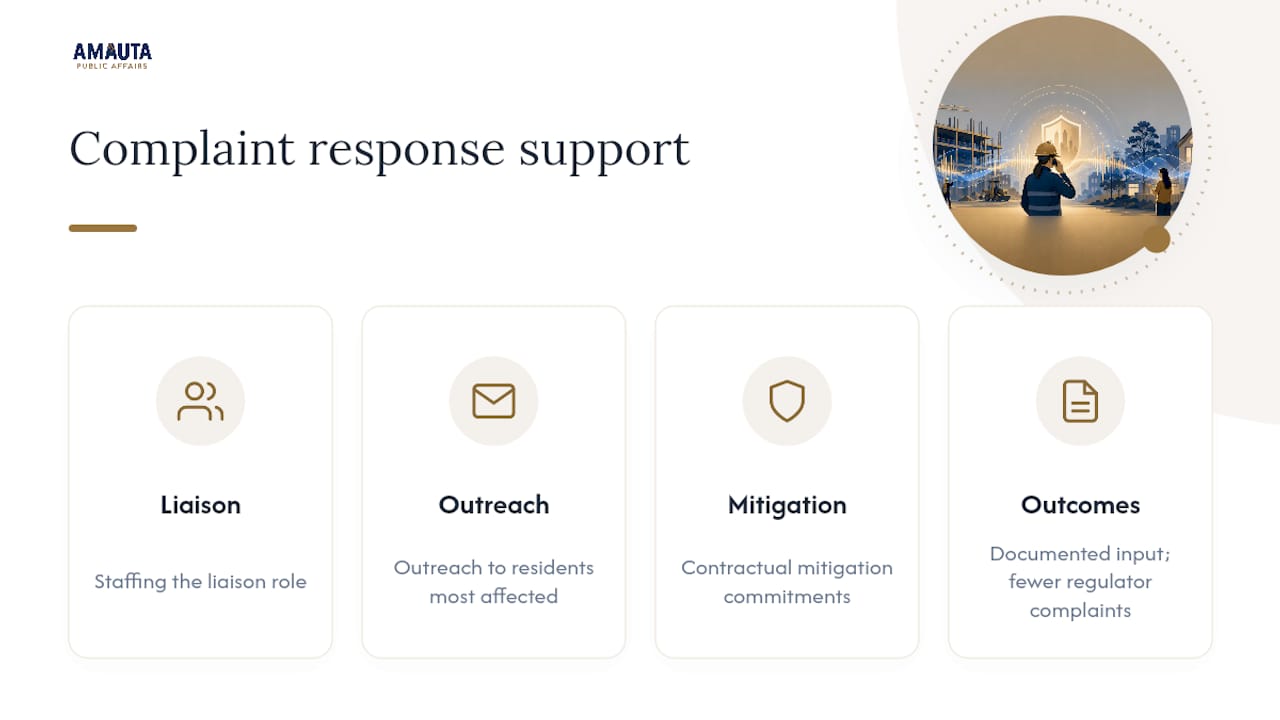
Handling a noise complaint well takes more than good intentions. It takes a liaison who’s actually available, outreach that reaches the residents most affected, and mitigation commitments a contractor is contractually bound to honor. Such infrastructure is built for developers and public agencies managing land-use and infrastructure projects, including staffing the liaison role, running the stakeholder mapping, and drafting communications that keep regulators and neighbors informed before frustration turns into a formal complaint.
That work also extends to physical disruption beyond noise. When facade cleaning or exterior maintenance disrupts residents during a project, the same outreach principles for minimizing resident disruption apply.
The outcome includes documented community input, fewer complaints reaching regulators, and mitigation commitments that hold up under scrutiny. Review Amautapublicaffairs’s community engagement and permitting services and request a consultation to build your complaint response plan before your next complaint arrives, not after.
Where to Find the Technical and Policy Guidance
The FHWA Construction Noise Handbook details mitigation hierarchy and contract enforcement mechanisms. WSDOT’s noise policy and the VDOT noise guidance manual cover state-level assessment thresholds and public involvement requirements. The I-INCE guidance outlines staged community noise assessment, and the FMSIB toolkit offers practical engagement templates for identifying affected communities early.
Sources
Recommended
Comments