
90 Day Stakeholder Engagement Plan With Templates and Metrics

A stakeholder engagement plan (SEP) is the documented strategy for identifying whom a project affects, defining how deeply each group should be engaged, and scheduling the communication and feedback loops that keep that engagement measurable. The immediate action is straightforward: build or update a stakeholder register and set a specific engagement objective, mapped to an IAP2 engagement level, for whichever stakeholders carry the most influence over your project’s outcome right now.
TL;DR:
A stakeholder engagement plan must include a detailed stakeholder register, clear engagement objectives, a communication plan, a grievance mechanism, monitoring indicators, and a budget.
The scope of the plan should be scaled based on project risk, with high-risk projects requiring comprehensive components like grievance processes and impact monitoring.
Building and maintaining an effective SEP involves continuous stakeholder mapping, setting measurable signals, regular reviews, and adjusting tactics based on feedback and sentiment trends.
Success depends on assigning specific ownership of engagement actions and ensuring transparent, two-way communication that incorporates stakeholder feedback into ongoing planning.
Missing or outdated stakeholder registers and ineffective follow-through are common failures that undermine trust and project progress, especially in land-use or infrastructure projects.
Table of Contents
What Is a Stakeholder Engagement Plan, and When Do You Need One?
How Do You Build a Stakeholder Engagement Plan Step by Step?
How Do You Handle Grievances and Measure Whether Engagement Works?
How AMAUTA Public Affairs Turns Engagement Commitments Into Measurable Signals
What Are the Most Common Stakeholder Engagement Plan Mistakes?
What Does a 90-Day Stakeholder Engagement Action Plan Look Like?
What Legal and Ethical Rules Apply to Stakeholder Engagement?
What Do You Learn From Running Stakeholder Engagement Plans on Land-Use Projects?
How Can AMAUTA Public Affairs Help You Run a Stakeholder Engagement Plan?
Where Can You Find More Stakeholder Engagement Templates and Guidance?
What Belongs in a Stakeholder Engagement Plan Checklist?
Before drafting anything lengthy, check the plan against the elements that separate a working SEP from a document nobody opens again. Every high-risk project template built by institutions like the World Bank and IFC converges on the same core components, and skipping any one of them tends to surface later as a stalled permit, a hostile comment period, or a coalition that feels ambushed.
Run your draft against this list:
Stakeholder register: names, organizations, contact details, interest, influence level, and preferred language or channel for each entry.
Engagement objectives: a stated current engagement level and a desired one, tied to a decision or milestone, not a vague aspiration to “build support.”
Communication plan: specific channels, message themes, frequency, and a named owner for each stakeholder group.
Grievance mechanism: an intake method, an acknowledgment timeline, and an escalation path for unresolved complaints.
Monitoring indicators: measures like responsiveness rate or sentiment trend that tell you whether engagement is working, not just whether it happened.
Budget line: dedicated funding for translation, meeting space, staff time, and materials, sized to the project’s risk level.
If any of these six items is missing, the plan is incomplete no matter how polished the narrative sections read. A stakeholder engagement strategy without a grievance mechanism, for instance, tends to produce complaints that get shared with a reporter before they ever reach the project team.
What Is a Stakeholder Engagement Plan, and When Do You Need One?
A stakeholder engagement plan documents who a project affects, how the project team intends to engage each group, and how success will be measured against project milestones. It is proportionate by design: a neighborhood infill project might run on a two-page plan, while a substantial-risk energy or infrastructure development typically needs the full structure that the World Bank’s SEP template lays out, including a grievance mechanism, monitoring indicators, and budget annexes.
Scale the document to the project’s risk profile and regulatory exposure. A full SEP becomes necessary once a project triggers formal permitting review, involves displacement or land acquisition, affects a vulnerable population, or draws organized opposition. Below that threshold, a lighter engagement plan with a register and a communication schedule usually covers the need.
The IAP2 spectrum gives project managers a shared vocabulary for how deeply to engage each group: Inform (one-way updates), Consult (gather input, no promise to act on it), Involve (input directly shapes decisions), Collaborate (joint decision-making), and Empower (the stakeholder group makes the final call on a defined element). Most land-use and infrastructure projects sit between Consult and Involve for the general public, while directly affected property owners or displaced residents often warrant Collaborate.
None of this works without two-way communication. A peer-reviewed framework for building stakeholder engagement plans argues that feedback has to actually revise the plan, not just get logged and filed. If a consultation produces the same action items every time regardless of what stakeholders say, the mechanism isn’t working. That is why measurement belongs in the plan from day one, not as an afterthought bolted on after a project runs into trouble.
How Do You Build a Stakeholder Engagement Plan Step by Step?
Building a usable SEP follows a sequence. Skip a step and the plan tends to look complete on paper while failing the first time a stakeholder pushes back with a question the team can’t answer.
1. Identify every stakeholder and build the register
Start wide, then narrow. Pull names from permit applicants lists, prior public comment records, homeowner association rosters, elected district maps, environmental review sign-in sheets, and internal staff knowledge of who has shown up to similar projects before. A stakeholder register should capture, at minimum:
Name and organization (or “unaffiliated resident” where relevant)
Contact information and preferred language
Category (regulator, elected official, neighbor, advocacy group, media, business owner)
Known position or concern, if already expressed
Influence level and interest level (populated in step two)
Assigned relationship owner on the project team
Miss a category here and the gap surfaces later as a surprised city council member or an advocacy group that feels shut out of a process it should have been part of from the start.
2. Map and prioritize using a power/interest grid
Plot every register entry on a simple grid: influence over the project’s outcome on one axis, level of interest in the project on the other. Four quadrants emerge:
High influence, high interest — these stakeholders need the deepest engagement (Involve or Collaborate) and the most frequent contact.
High influence, low interest — keep satisfied with periodic, high-level updates; a sudden problem can activate their influence fast.
Low influence, high interest — inform consistently; this group often becomes an advocate or a critic depending on how well they’re kept in the loop.
Low influence, low interest — monitor with minimal effort; light-touch updates are enough.
This mapping exercise is where a stakeholder mapping workshop earns its time. A structured 60 to 90 minute session with the core project team surfaces disagreements about who actually holds influence, which is a conversation better held early than discovered mid-permit-hearing.
3. Set current versus desired engagement levels
For each priority stakeholder or stakeholder group, name where they sit today on the IAP2 spectrum and where they need to be by a specific milestone. “Increase the neighborhood association from Inform to Consult before the planning commission hearing on [date]” is a measurable objective. “Build community support” is not. The gap between current and desired level tells you what tactics to deploy and how much lead time you need.
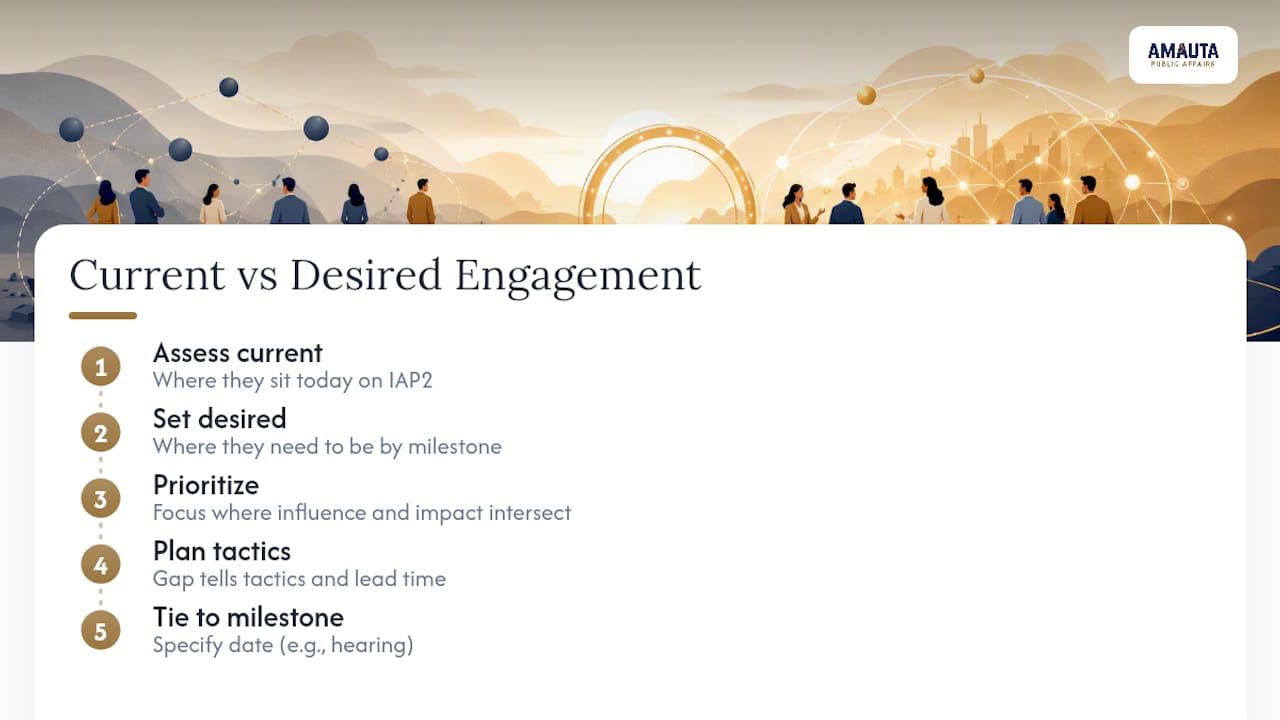
Prioritize based on where influence and impact intersect rather than spreading identical effort across every name in the register. A city council member who controls a critical vote deserves more staff time than a resident who has never attended a meeting, even if both technically qualify as “stakeholders.”
4. Design actions, assign owners, and set cadence
Every stakeholder group needs a defined action, a channel, an owner, and a frequency. A sample cadence table might look like this:
Stakeholder group | Action | Channel | Owner | Cadence |
Adjacent property owners | Direct notification and Q&A | Door knock + letter | Community liaison | Once at project launch, then before each hearing |
Planning commission | Briefing memo | Email + in-person | Project lead | Two weeks before each vote |
Local advocacy group | Working session | In-person meeting | Public affairs lead | Monthly |
General public | Project update | Website + local paper | Communications lead | Quarterly |
Assign a single named owner per group, not “the team.” Vague ownership is how engagement actions quietly stop happening after the third month. Documenting who owns each engagement action and building it into a direct reporting line keeps engagement tied to project decisions instead of floating as a side activity nobody tracks.
5. Draft the message template and validate it before sending
A short message template forces discipline: state the project stage, what’s changing, what input is being requested, how input will be used, and where to direct questions. Draft one master template per stakeholder category, then adjust tone and detail level rather than writing from scratch for every contact. This also makes translation for non-English speaking stakeholders far more manageable, since only the templates need translating rather than every individual communication.
Sequencing matters as much as the content. If you engage a low-influence group before briefing the elected official who controls the vote, you risk that official hearing about the project secondhand, which tends to sour the relationship before the plan even gets off the ground. A customized community engagement strategy built around the specific project, rather than a generic template applied uniformly, tends to catch this kind of sequencing risk before it becomes a problem.
How Do You Handle Grievances and Measure Whether Engagement Works?
A grievance mechanism is the formal channel stakeholders use to raise a complaint, and it needs three components to function: an intake method (phone, email, web form, or in-person), an acknowledgment timeline (commonly 5 to 10 business days), and an escalation path for anything unresolved at the first level. The IFC’s stakeholder engagement guidance treats grievance management as one of its core components precisely because unresolved complaints are what tend to escalate into formal opposition, media coverage, or legal challenges.
Log every grievance in a dedicated register separate from the general stakeholder register: date received, issue summary, stakeholder involved, response given, date closed. This register becomes your evidence trail if a regulator or opposing party later questions whether the project handled community concerns in good faith.
Signal check: a plan is only as good as its ability to show whether engagement changed anything. Design each commitment with a readable metric attached, such as a responsiveness rate tracking the share of issues answered within the agreed timeframe.
Core indicators worth tracking on a recurring basis:
Responsiveness rate — percentage of raised issues answered within the committed window.
Resolution rate — percentage of grievances closed to the stakeholder’s satisfaction, not just closed administratively.
Participation quality — attendance with substantive input received, not attendance alone.
Sentiment trend — tracked across at least three contact points per stakeholder group, so you catch a shift before it becomes a public objection.
Report these indicators on a fixed cadence, monthly for active projects, and share a plain-language summary with stakeholders themselves. When responsiveness drops or sentiment trends negative, that’s the trigger to adjust tactics, not just to note the number and move on.
What Does a Stakeholder Engagement Plan Template Look Like?
A one-page SEP structure, drawn from the components institutions like the World Bank and IFC use for high-risk projects, covers seven fields: project description, engagement objectives, stakeholder identification summary, engagement program (by group), grievance mechanism, monitoring plan, and budget. Each field needs only a few lines for a small project and a full page for a substantial-risk one.
A sample stakeholder register row looks like this:
Name/Org: Riverside Neighborhood Association
Category: Community group
Interest: High (adjacent to project site)
Influence: Medium (no formal vote, active in local media)
Current level: Inform
Desired level: Consult
Owner: Community liaison
Next action: Invite to pre-application meeting, [date]
A short communication schedule sample:
Channel | Message | Owner | Cadence |
Project website | Milestone updates | Communications lead | Monthly |
Direct mail | Notice of public hearing | Project lead | Per hearing |
Community meeting | Design feedback session | Public affairs lead | Once per design phase |
For stakeholders facing participation barriers, whether language, mobility, work schedules, or lack of childcare, the plan should name the specific accommodation: translated materials, small-group sessions held outside standard business hours, or transportation assistance. The World Bank’s guidance on inclusive engagement treats this as a budgeted line item, not a footnote, because removing a real barrier costs money and staff time that needs to be planned for in advance.
How AMAUTA Public Affairs Turns Engagement Commitments Into Measurable Signals
Stakeholder engagement plans are most effective when built like a campaign: assessing the landscape first, setting priorities, and attaching measurable signals to commitments so progress can be evaluated against real outcomes rather than intentions.
Workshop outputs typically include a completed power/interest grid, a stakeholder register populated with real names and owners, and a draft communication schedule ready for the team to execute against. Attaching a signal to a commitment might look like this in practice:
Commitment: “Respond to neighborhood concerns promptly” becomes a tracked responsiveness rate, measured as the share of raised issues answered within an agreed window.
Commitment: “Build trust with the business district” becomes a trust trend, tracked through sentiment recorded across three separate contact points.
Pro Tip: Write the signal before you write the commitment. If you can’t describe how you’ll measure whether a promise was kept, the promise probably needs rewording.
The mapping workshops run in a focused 60 to 90 minute session with the core project team, using the same stakeholder mapping templates referenced earlier in this article, producing a register and grid the team can act on immediately rather than a slide deck that gets filed away.
What Are the Most Common Stakeholder Engagement Plan Mistakes?
The most common failure mode is treating the stakeholder register as a static list built once at project kickoff and never revisited. A PMP-aligned analysis of engagement strategy execution flags this as the recurring gap between plans that look thorough on paper and plans that actually function: stakeholder positions shift, new groups emerge, and a register frozen at month one misses all of it.
Fixes that cost little and pay off fast:
Schedule quarterly register reviews. Put a recurring calendar reminder on it; don’t rely on memory.
Separate activity metrics from effect metrics. Meetings held is an activity count. Sentiment shift is an effect. Track both, but report the second as your measure of success.
Mainstream engagement into project reporting, so stakeholder status appears on the same dashboard as budget and schedule, not in a separate document nobody in leadership reads.
Scale tactics to budget. A short phone-tree check-in with priority stakeholders costs almost nothing and catches problems weeks before a formal meeting would.
Pro Tip: If your stakeholder engagement budget is thin, spend it on the grievance mechanism first. A working complaint channel prevents more damage than an extra newsletter ever will.
What Does a 90-Day Stakeholder Engagement Action Plan Look Like?
A compact timeline gets a project from a blank page to a functioning engagement program inside one quarter.
Weeks 0–2: Build the stakeholder register from existing records and staff knowledge; run the power/interest mapping session with the core team.
Weeks 3–5: Reach out to high-priority stakeholders first; send initial messages using the drafted templates; log every response in the register.
Weeks 6–8: Hold the first round of consultations or workshops; launch the grievance mechanism publicly, including how to file a complaint and expected response times.
Weeks 9–12: Collect baseline monitoring data; publish the first internal report on responsiveness and sentiment; adjust tactics for any stakeholder group showing a negative trend.
By week 12, the plan should have produced at least one measurable indicator, not just a stack of meeting notes.
What Legal and Ethical Rules Apply to Stakeholder Engagement?
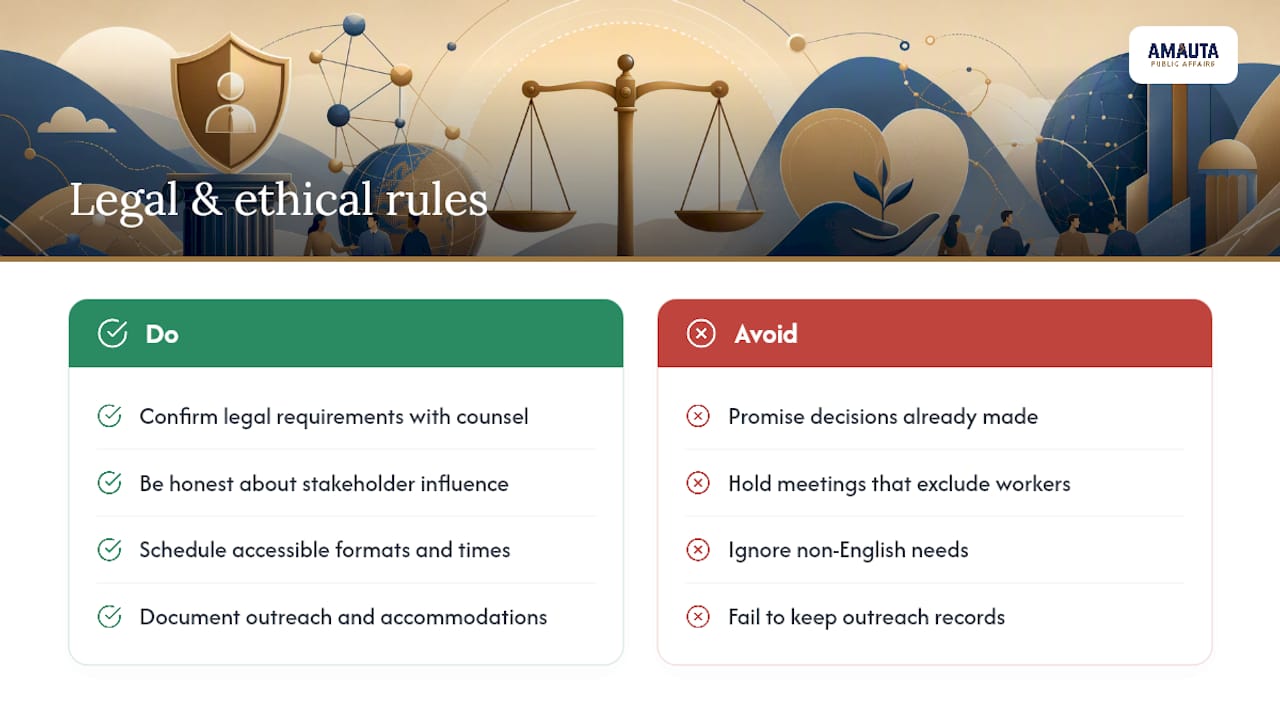
Legal obligations around stakeholder engagement vary by jurisdiction and by the type of approval a project needs, so treat any specific procedural requirement, such as public notice periods, hearing formats, or documentation retention rules, as a matter to confirm with legal counsel or the relevant permitting authority rather than a general industry norm. What holds across most contexts is the ethical baseline: engagement has to be honest about what stakeholders can actually influence.
Telling a community group their input will shape a decision when the decision has effectively already been made is both an ethical failure and a practical one. It burns trust that a project may need again at the next phase, and it tends to surface publicly once stakeholders compare notes. The IAP2 spectrum exists partly to prevent this: naming a stakeholder group’s engagement level as “Consult” rather than “Involve” is more honest than promising collaboration you don’t intend to deliver.
Equity considerations carry their own weight. Engagement processes that are technically open to everyone but scheduled at times or in formats that exclude working residents, non-English speakers, or people without reliable transportation raise fairness concerns even without a specific legal mandate. Documenting outreach to vulnerable or historically underrepresented groups, and the specific accommodations offered, protects the project’s credibility if the engagement process is ever challenged. Keep records of all outreach attempts, responses received, and accommodations made. That documentation is often what distinguishes a defensible process from one that looks, in hindsight, like a formality.
What Do You Learn From Running Stakeholder Engagement Plans on Land-Use Projects?
The lesson that took longest to sink in is that a beautifully mapped stakeholder register means nothing if nobody owns the follow-through. Early in any land-use or infrastructure engagement, the mapping exercise is the easy part. Teams enjoy it, it produces a satisfying grid, and it feels like progress. The harder discipline is the boring one: someone has to actually call the neighborhood association back three weeks later, and someone has to check whether the grievance filed in March got a real answer by April.
The plans that hold up under pressure, particularly once a project draws organized opposition, are the ones where every commitment carries a number attached to it. Not “we’ll stay in touch,” but “response within five business days,” tracked and reported. That single habit, treating engagement as data rather than as goodwill, changes how a team behaves under deadline pressure. It’s the difference between a plan that gets updated and one that gets abandoned the first time the schedule gets tight.
If there’s one habit worth building before the next project kicks off, it’s this: revisit the register on a fixed schedule, not when a crisis forces it. Structured stakeholder mapping workshops tend to catch blind spots a team assumes it doesn’t have.
— Ignacio
How Can AMAUTA Public Affairs Help You Run a Stakeholder Engagement Plan?
Building a stakeholder engagement plan from scratch on top of an already full project schedule is where most plans stall before they start. Amautapublicaffairs runs the workshop, the mapping, and the follow-through as a single engagement, so a project team gets a completed register, a prioritized power/interest grid, and a communication schedule ready to execute, without pulling internal staff off their existing workload for weeks to build it from a blank template.
A typical engagement starts with a stakeholder mapping workshop, moves into a documented plan built around a project’s risk profile and timeline, and continues with implementation support so grievance mechanisms, communication cadence, and monitoring indicators remain active. This approach applies to land use, energy, and infrastructure projects where community opposition or permitting delay carry significant costs. If you’re preparing for a permit hearing, a rezoning vote, or early-stage community outreach, review AMAUTA’s services and get a plan built around your project’s actual risk profile rather than a generic template.
Where Can You Find More Stakeholder Engagement Templates and Guidance?
A handful of primary sources cover the ground this article draws from, and they’re worth bookmarking directly:
World Bank SEP Template for High- and Substantial-Risk Projects — the official structure most substantial-risk infrastructure and land-use SEPs are built around, including grievance and monitoring annexes.
IFC Stakeholder Engagement Guidance and Tools — practical, stepwise guidance covering identification, disclosure, and grievance management.
IAP2 engagement spectrum — the five-level framework for matching engagement depth to stakeholder needs.
Ten simple rules for developing a stakeholder engagement plan — a concise, practitioner-oriented set of rules on iterative planning and feedback loops.
For teams looking to connect engagement strategy to broader execution discipline, this strategy execution framework offers a useful complement on assigning ownership and tracking follow-through beyond the engagement plan itself.
Sources
Recommended
Comments