
Nonprofit Crisis Communications: What Leaders Must Know

Nonprofit crisis communications is the strategic management of messaging during events that threaten an organization’s reputation or operations, aimed at safeguarding stakeholder trust and ensuring mission continuity. When a financial scandal surfaces, a program failure goes public, or a data breach hits the news cycle, the organizations that respond with speed and transparency survive. Those that improvise under pressure rarely do. Understanding what nonprofit crisis communications requires, and building the capacity before a crisis arrives, is one of the most consequential investments a nonprofit leader can make.
What is nonprofit crisis communications?
Nonprofit crisis communications is a structured discipline focused on controlling information flow and messaging during incidents that carry significant reputational, operational, or legal risk. It is distinct from general public relations in one critical way: it operates under time pressure, with incomplete information, and with stakeholder trust directly on the line. The crisis communication framework protects reputation and stakeholder relationships through timely, transparent messaging and coordinated outreach across all relevant channels.
Defining what actually constitutes a crisis matters as much as knowing how to respond. Experienced communications professionals treat “what counts as a crisis” as a decision threshold, not a feeling. Objective criteria include significant reputational damage risk, safety concerns, active media inquiries, social media traction, and leadership escalation. This threshold-based approach prevents two equally damaging mistakes: over-activating crisis protocols for minor incidents, and under-responding when a real crisis is unfolding.

For nonprofits specifically, the stakes are amplified. Donor confidence, government contracts, community partnerships, and volunteer engagement all depend on perceived integrity. A single mishandled statement can fracture relationships that took years to build. Crisis communication is not a reactive afterthought. It is a prerequisite for mission resilience.
What are the essential components of a nonprofit crisis communication plan?
A nonprofit crisis communication plan is most effective when it functions as a concise operational cheat sheet covering who says what, when, and through which channel. Document perfection is not the goal. Clarity and speed of activation are.
Every plan should include the following components:
Pre-identified approval chain. During a crisis, you won’t have time to build a new approval process from scratch. Designate in advance who approves messaging for different crisis types, including board involvement thresholds.
Stakeholder contact list. Maintain current contact information for donors, major funders, media contacts, community partners, government liaisons, and legal counsel. Outdated lists are a common failure point.
Pre-written holding and update statements. Draft template statements for the most likely crisis scenarios: financial irregularities, program failures, staff misconduct, and data incidents. These buy critical time while facts are verified.
Legal and financial triggers. Identify the specific conditions that require legal review before any public statement is released. This prevents well-intentioned but legally damaging disclosures.
Communication channels by audience. Map which channels reach which audiences. Donors may require direct email. Media requires a designated spokesperson. Staff requires internal briefings before any external release.
Maintenance schedule. Plans that are written and shelved become liabilities. Build in a review cycle tied to annual planning or triggered by any significant incident.
Pro Tip: Run a tabletop exercise at least once a year using a realistic scenario specific to your organization’s risk profile. A 90-minute session with leadership, communications staff, and legal counsel will reveal gaps in your plan that no document review ever will.
How does crisis communication differ from crisis management in nonprofits?
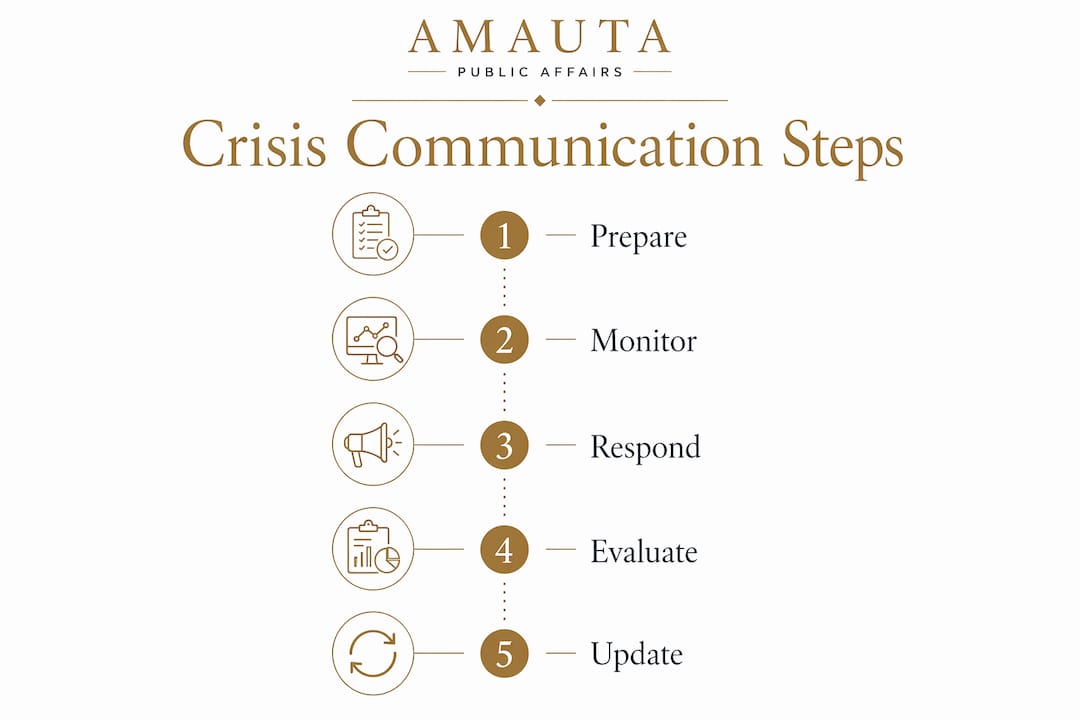
Crisis communication and crisis management are related but distinct functions. Conflating them creates organizational confusion at exactly the wrong moment.
Crisis communication focuses on messaging and information flow: what is said, to whom, through which channel, and in what sequence. Crisis management focuses on operational response and damage control: what actions are taken to contain the incident, restore services, and address root causes. Both must operate simultaneously during a crisis, but they require different owners, different skills, and different success metrics.
Focus Area | Crisis Communication | Crisis Management |
Primary goal | Protect reputation and stakeholder trust | Contain the incident and restore operations |
Core activities | Messaging, spokesperson coordination, media response | Incident response, service restoration, legal action |
Primary owner | Communications director or designated lead | Executive director or operations leadership |
Success metrics | Message consistency, stakeholder trust retention | Incident containment time, service restoration speed |
Key tools | Holding statements, media briefs, stakeholder updates | Incident logs, legal counsel, operational protocols |
The most effective nonprofit responses treat these two tracks as parallel and synchronized, not sequential. Waiting for operations to stabilize before communicating externally is a common mistake. Stakeholders, particularly media and major donors, fill information vacuums with speculation. A communications lead integrated into incident command ensures messaging strategy stays aligned with the operational response in real time, rather than lagging behind it.
What are best practices for effective nonprofit crisis communication?
The most effective nonprofit crisis communication strategies are built before incidents occur. Crafting strategies before incidents ensures message continuity and discipline under pressure. When a crisis hits, the capacity for creative strategy collapses. Organizations default to whatever systems and habits already exist.
Follow this sequence of practices to build genuine crisis communication capability:
Prioritize speed and transparency in early communication. The University at Albany’s crisis communication guidance is direct: speed matters in early phases, and transparency is prioritized over deflection even when full information is unavailable. Saying “We are aware of the situation and are actively gathering facts” is far more credible than silence.
Conduct scenario planning and risk assessment. Bridgespan’s crisis management resources for US nonprofits emphasize scenario planning and decision-making under uncertainty as foundational preparation. Identify your top five crisis scenarios and build response frameworks for each.
Assign spokespersons by audience type. The executive director may be the right voice for major donors and board members. A program director may be more credible with community partners. A communications officer handles media. Assigning roles in advance prevents the chaos of real-time spokesperson decisions.
Develop tailored messages for internal and external audiences. Staff need different information than the public. Internal audiences require context, reassurance, and clear guidance on what they can and cannot say. External audiences need factual updates and evidence of accountability.
Maintain two synchronized communication tracks. The dual-track approach separates internal alignment on facts and approvals from the external message pack. The external track starts with a holding statement that buys time while internal verification and routing happens. The first public post often becomes the baseline narrative, so it must be deliberate.
Engage professional communications support when needed. Many nonprofits lack in-house crisis communications expertise. Partnering with a public affairs firm during high-stakes incidents is not a sign of weakness. It is a sign of organizational maturity.
Conduct post-crisis debriefs and update your plan. Every incident, including near-misses, generates lessons. Document what worked, what failed, and what the plan missed. Update templates, contacts, and protocols before the next cycle begins.
Pro Tip: Many real-world issues begin as issues management rather than full crises. Use a protocol involving leadership and legal counsel to assess whether an incident warrants crisis activation. Escalating unnecessarily drains organizational capacity and desensitizes teams to genuine emergencies.
How can nonprofits prepare and maintain crisis communications capabilities?
Preparation is where most nonprofits fall short. A crisis communication plan written two years ago, with outdated contacts and untested templates, provides false confidence. The plan’s real value comes from running lightweight rehearsal and maintenance loops so templates, contacts, and roles stay current.
Effective preparation includes these ongoing activities:
Annual plan reviews tied to organizational planning cycles. Review the full plan once per year at minimum. Update contact lists, spokesperson assignments, and messaging templates to reflect current staff and organizational priorities.
Post-incident reviews after any significant event. Even incidents that do not fully activate crisis protocols reveal gaps. Treat every close call as a rehearsal opportunity.
Tabletop exercises with leadership and legal counsel. Simulated scenarios expose decision-making gaps that document reviews miss entirely. A 90-minute exercise with the right participants is worth more than a 40-page plan that no one has practiced.
Technology and channel audits. Verify that your communication tools, email platforms, social media access credentials, and media contact databases are current and accessible to the right people. During a crisis, discovering that the communications director is the only person with social media login credentials is a preventable failure.
The following table outlines a practical maintenance schedule for nonprofit crisis communication plans:
Activity | Frequency | Owner |
Full plan review and update | Annual | Communications director |
Contact list verification | Biannual | Communications or operations staff |
Tabletop exercise | Annual | Executive director and communications lead |
Post-incident debrief | After any significant incident | Leadership team |
Technology and channel audit | Annual | Communications and IT staff |
The organizations that handle crises well are rarely the ones with the most sophisticated plans. They are the ones that practice, update, and treat crisis readiness as a standing operational priority rather than a one-time project.
Key takeaways
Nonprofit crisis communications succeeds when organizations build clear roles, pre-written messaging, and rehearsal cycles before any incident occurs, not during one.
Point | Details |
Define crisis thresholds clearly | Use objective criteria like reputational risk and media inquiries to decide when to activate crisis protocols. |
Build the plan before the crisis | Pre-written statements, pre-identified approvers, and current contact lists are the difference between control and chaos. |
Separate communication from management | Crisis communication owns messaging; crisis management owns operations. Both must run simultaneously. |
Prioritize speed and transparency | Early, honest communication protects stakeholder trust even when full information is unavailable. |
Maintain through practice, not paperwork | Lightweight rehearsal cycles and post-incident reviews keep plans effective when they matter most. |
Why crisis communication planning is the most undervalued nonprofit investment
From my experience working with organizations across the public affairs spectrum, the pattern is consistent: nonprofits invest in programs, fundraising, and compliance, and treat crisis communication as something to figure out when the time comes. That assumption is the single most common root cause of preventable reputational damage I observe.
The organizations that handle crises with credibility are not necessarily the ones with the largest communications budgets. They are the ones where someone, at some point, sat in a room and asked: “What would we actually do if this happened tomorrow?” They wrote down the answer, tested it, and updated it. That discipline, more than any sophisticated messaging framework, is what separates organizations that emerge from crises intact from those that do not.
The other pattern I see consistently is the conflation of silence with caution. Leaders who delay communication because they want to “get all the facts first” often discover that the narrative has already been written by others. Transparency does not require certainty. It requires honesty about what you know, what you do not know, and what you are doing about it. That posture, communicated early and consistently, is what stakeholders remember.
Nonprofits with limited resources should not treat this as a reason to defer planning. A one-page crisis communication cheat sheet, a current contact list, and one annual tabletop exercise cost almost nothing. They are, however, worth everything when a crisis arrives.
— Ignacio
How Amautapublicaffairs supports nonprofits in crisis
When a crisis surfaces, the margin for error is narrow and the pressure to communicate is immediate. Amautapublicaffairs brings a campaign-style approach to nonprofit crisis communications, combining rapid response support with tailored messaging strategies built around your organization’s specific risk profile and stakeholder relationships.

From developing pre-crisis communication plans to providing real-time guidance during active incidents, Amautapublicaffairs delivers the kind of structured, audience-specific support that nonprofit leaders need when it matters most. The firm’s expertise in stakeholder engagement and media relations translates directly into message consistency and trust protection during high-stakes moments. If your organization does not yet have a tested crisis communication plan, now is the right time to build one. Connect with Amautapublicaffairs to start the conversation.
FAQ
What is nonprofit crisis communications?
Nonprofit crisis communications is the strategic management of information and messaging during events that threaten an organization’s reputation or operations. Its purpose is to protect stakeholder trust and enable the nonprofit to continue its mission through timely, transparent outreach.
What should a nonprofit crisis communication plan include?
A nonprofit crisis communication plan should include a pre-identified approval chain, current stakeholder contact lists, pre-written holding statements, legal and financial triggers, channel assignments by audience, and a maintenance schedule. The plan functions best as a concise operational reference, not a lengthy document.
How is crisis communication different from crisis management?
Crisis communication focuses on messaging, spokesperson coordination, and information flow to external and internal audiences. Crisis management focuses on operational response, incident containment, and service restoration. Both functions must run simultaneously during a crisis, with a communications lead integrated into the incident command structure.
When should a nonprofit activate its crisis communication plan?
Nonprofits should activate crisis communication protocols when an incident meets objective criteria such as significant reputational damage risk, safety concerns, active media inquiries, or social media traction. Treating activation as a threshold decision rather than a judgment call prevents both under-response and unnecessary escalation.
How often should nonprofits update their crisis communication plans?
Nonprofits should review and update their crisis communication plans at least annually, and after any significant incident. Contact lists, spokesperson assignments, and messaging templates should be verified at least twice per year to prevent stale information from undermining response effectiveness during real events.
Recommended
Comments