
What Is a Policy Advocacy Campaign? 2026 Guide

A policy advocacy campaign is a structured, coordinated effort by organizations, coalitions, or individuals to change public policies and related systems by engaging decision-makers through education, data sharing, awareness-building, and mobilized action. Unlike a single letter to a legislator or a one-time public comment, a campaign operates across multiple channels, involves diverse stakeholders, and sustains pressure over time. NGOs, think tanks, community coalitions, and professional associations all run these campaigns to shift laws, regulations, or institutional practices. Understanding what a policy advocacy campaign requires, from objective-setting to compliance, is the prerequisite for running one that actually moves policy.
What is a policy advocacy campaign and how does it work?
A policy advocacy campaign differs from one-off advocacy actions in scope, coordination, and duration. Campaigns involve multiple steps, stakeholders, and communication channels working in concert to influence decisions, rather than a single message delivered once. That distinction matters because isolated advocacy rarely builds the sustained pressure needed to shift entrenched policy positions.
The standard industry term for this practice is policy advocacy, and it encompasses both lobbying and non-lobbying activities. What is advocacy in policymaking, precisely? It is the deliberate use of information, relationships, and public pressure to move decision-makers toward a specific policy outcome. Campaigns operationalize that definition by organizing advocacy into phases, assigning roles, and tracking progress against clear goals.

Key actors in any campaign include NGOs, which conduct research and publish reports that support policy arguments; think tanks, which provide analytical credibility; and community coalitions, which supply the grassroots legitimacy that elected officials respond to. Advocacy groups and think tanks publish free reports and sometimes advocate political positions, giving campaigns a ready supply of credible evidence. That evidence, combined with organized stakeholder engagement, forms the core engine of effective advocacy.
Core components of a successful advocacy campaign
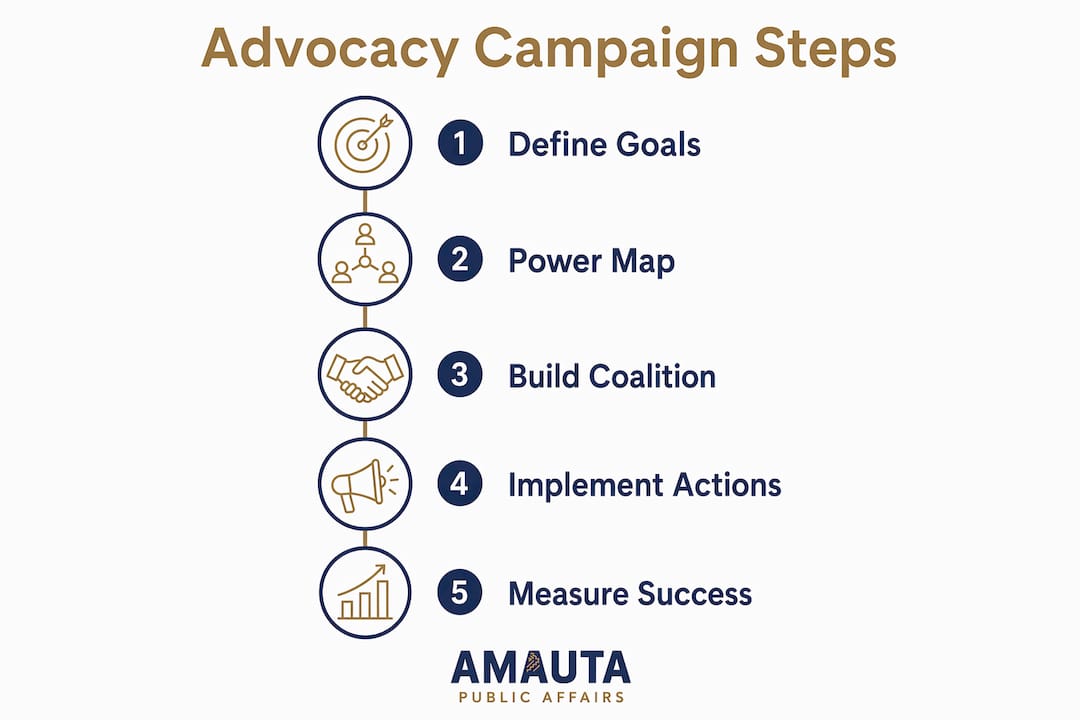
Every high-performing policy advocacy campaign is built on the same foundational architecture, even when the specific issue, geography, or audience differs. The Oxfam Influencing for Impact Guide describes a strategy design process that begins with objective-setting and moves through power analysis, tactic selection, and narrative development. That sequence is not arbitrary. Each phase informs the next, and skipping steps produces campaigns that are busy but not effective.
The phases of a well-designed campaign follow this progression:
Set clear, specific objectives. Define the exact policy change sought, the decision-maker who controls it, and the timeline for action. Vague goals produce vague campaigns.
Conduct power and context analysis. Map who holds formal authority, who influences that authority informally, and what political conditions make change more or less likely right now.
Build your coalition. Identify likely allies and opponents early. Identifying allies and opponents early enables framing advocacy as mutually beneficial, which increases the probability of policy success.
Develop your narrative and materials. Craft messaging that connects data to lived experience and speaks directly to the values of your target decision-makers.
Select and deploy tactics across channels. Use press releases, op-eds, social media, direct meetings, and action alerts in a coordinated sequence rather than in isolation.
Monitor, adjust, and sustain. Track legislative timelines, engagement metrics, and coalition health. Adjust tactics based on what the evidence shows.
The distinction between direct and grassroots lobbying matters at the planning stage, not just at the compliance stage. Direct lobbying targets legislators directly on specific legislation. Grassroots lobbying asks the public to contact legislators. Both require different resource tracking for tax-exempt organizations, so building that distinction into your campaign architecture from day one prevents costly compliance problems later.
Pro Tip: Map your power analysis on a simple two-by-two grid: high influence versus low influence on one axis, supportive versus opposed on the other. This single tool clarifies where to invest relationship-building time and where to focus persuasion efforts.
What policy advocacy strategies actually work?
The most effective policy advocacy strategies combine credible research, compelling narrative, and organized public pressure. No single tactic wins a campaign alone. The Oxfam guide confirms that strong narratives matched to context and power dynamics shift outcomes in ways that more communication volume alone cannot.
The table below compares lobbying and non-lobbying advocacy tactics, which is a distinction every campaign planner must understand:
Tactic | Type | Best used when |
Direct legislator meetings | Direct lobbying | You have access and a specific bill to influence |
Grassroots action alerts | Grassroots lobbying | You need to demonstrate broad public support |
Research reports and white papers | Non-lobbying advocacy | You need to establish credibility and frame the issue |
Op-eds and media placements | Non-lobbying advocacy | You want to shift public opinion and signal momentum |
Testimony at public hearings | Non-lobbying advocacy | A formal record of expert or community voice is needed |
Coalition sign-on letters | Non-lobbying advocacy | You want to show breadth of support to decision-makers |
Community rallies | Grassroots mobilization | Visible public pressure is strategically timed |
Non-lobbying activities form the majority of most campaigns. Research, public education, media relations, and coalition coordination all build the conditions under which lobbying becomes effective. Campaigns that skip the groundwork and go straight to legislator contact often find that decision-makers have no context for the ask and no public pressure to act on it.
Digital and social media strategies deserve specific attention in 2026. Platforms like X (formerly Twitter), LinkedIn, and Instagram allow campaigns to reach both general audiences and policy-specific communities simultaneously. Action alerts distributed via email platforms like Mailchimp or Constant Contact can mobilize supporters to send letters or make calls within hours of a key legislative vote. The speed of digital mobilization has compressed advocacy timelines significantly, which means campaigns must have content and coalition infrastructure ready before a policy window opens, not after.
How do advocacy campaigns sustain momentum and measure success?
Campaigns function as a system of deliverables managed across multiple channels and stakeholders, rather than as a single communication push. That systems framing is the key to sustaining momentum. When a campaign is designed as a pipeline of letters, talking points, press placements, op-eds, and action alerts, each piece of content reinforces the others and keeps the issue visible across different audiences simultaneously.
Coalition continuity is the most underrated factor in long-term campaign success. High-performing campaigns design coalition participation with a stable core of committed members and a rotating set of variable allies who engage at key moments. This structure prevents coalition fatigue while maintaining the breadth of support that decision-makers notice.
Tracking the right metrics separates campaigns that learn from campaigns that simply execute. Useful metrics include:
Legislative milestones: Bill introductions, committee hearings, floor votes, and regulatory comment deadlines
Engagement metrics: Email open rates, action alert completion rates, social media reach, and media mentions
Relationship indicators: Number of legislator meetings held, coalition sign-ons secured, and editorial endorsements received
Policy outcomes: Amendments adopted, regulations modified, or budget allocations changed
Effective advocacy spans before, during, and after policy implementation, combining information sharing and mobilization across the full policy cycle. This means campaigns do not end when a bill passes. Sustained public support during implementation is what converts a legislative win into durable policy change.
Pro Tip: Set a 90-day campaign calendar at the outset with specific content deliverables assigned to specific team members. Campaigns that rely on spontaneous activity stall when the legislative calendar gets busy and everyone is already stretched.
Advocacy vs. lobbying: what nonprofits need to know
The legal distinction between advocacy and lobbying is the most misunderstood compliance issue for U.S. nonprofits running policy campaigns. Direct lobbying means communicating with legislators about specific legislation. Grassroots lobbying includes communications with the public that urge contact with legislators on specific legislation. Both definitions carry compliance implications under IRS rules for 501©(3) organizations.
Activities that fall outside lobbying definitions include:
Nonpartisan research and analysis, even when it addresses policy questions
Advocacy directed at executive branch agencies rather than legislatures
Responses to written requests from legislative bodies for technical assistance
Self-defense communications about legislation that directly affects the organization
Tax-exempt organizations operating under the 501(h) expenditure test can spend up to 20% of their exempt-purpose expenditures on lobbying, with grassroots lobbying capped at 25% of that total lobbying limit. Organizations that have not made the 501(h) election are subject to the vaguer “substantial part” test, which creates more legal uncertainty and is generally less favorable. Practitioners differentiate advocacy and lobbying within campaigns early to comply with U.S. nonprofit rules, since both require different resource tracking and reporting.
Pro Tip: If your organization has not yet made the 501(h) election, consult with a nonprofit attorney before launching any campaign that includes direct legislator contact. The election is simple to make and provides significantly clearer expenditure limits.
The practical implication for campaign planning is straightforward. Build a content inventory at the start of the campaign and classify each deliverable as lobbying or non-lobbying. That classification determines which budget line the activity draws from and what gets reported on Form 990. Organizations that consult advocacy professionals early in the planning process avoid the compliance scrambles that derail campaigns mid-cycle.
Key takeaways
A policy advocacy campaign succeeds when it combines clear objectives, power-mapped coalition strategy, a system of varied deliverables, and early compliance planning across the full policy cycle.
Point | Details |
Define before you deploy | Set specific policy objectives and identify the exact decision-maker before selecting any tactics. |
Coalition design is structural | Build a stable core coalition with rotating allies to maintain momentum across policy cycles. |
Lobbying is a subset of advocacy | Most campaign activities are non-lobbying; classify each deliverable early to stay compliant. |
Sustain beyond the vote | Advocacy continues through implementation; public support during that phase locks in policy gains. |
Systems beat single pushes | Campaigns managed as pipelines of varied content across multiple channels outperform single-message efforts. |
Why coalition strategy is the hardest part to get right
After working with organizations across multiple policy cycles, the component that most consistently determines campaign outcomes is not messaging quality or media coverage. It is coalition architecture. Most campaigns treat coalition building as a relationship task, a matter of making calls and getting sign-ons. The more accurate frame is that it is a design problem.
The organizations that sustain influence across multiple legislative sessions are the ones that have thought carefully about which partners need to be present at every stage and which partners are most valuable at specific moments. A community health organization might be a core member of a housing advocacy coalition because housing and health outcomes are inseparable in the data. A local business association might be a variable ally, engaged specifically when an economic framing is needed to reach a particular committee chair.
What I have found consistently is that campaigns underinvest in the “after” phase. When a bill passes or a regulation is finalized, most campaign teams exhale and move on. The organizations that build durable policy change stay engaged through implementation, monitor how agencies interpret new rules, and mobilize again when those interpretations drift from the original intent. That sustained presence is what separates a policy win from a policy change.
The compliance piece is also more manageable than most organizations fear. The IRS rules are specific enough that a well-organized content inventory and a clear budget classification system handle most of the complexity. The real risk is not the rules themselves. It is starting a campaign without that infrastructure in place and then trying to reconstruct it retroactively when an audit question arises.
For organizations new to policy advocacy campaigns, the most useful first step is a power and context analysis conducted before any public-facing activity begins. That analysis shapes every subsequent decision, from which coalitions to build to which tactics to deploy and when.
— Ignacio
How Amautapublicaffairs supports your advocacy campaign
Amautapublicaffairs designs and executes policy advocacy campaigns with the same campaign-style discipline it applies to land use and community engagement challenges. Every engagement begins with a granular assessment of the policy context, stakeholder landscape, and communication opportunities specific to your issue.
The firm’s services cover the full campaign architecture: strategic messaging, coalition coordination, media relations, digital advocacy, and compliance-aware planning. Whether you are launching a first-time advocacy effort or scaling an existing campaign to reach new decision-makers, Amautapublicaffairs builds the infrastructure that sustains momentum beyond a single legislative window. The team’s results-driven approach means tactics are continuously refined based on real-time feedback, not fixed at the outset. Connect with the team to discuss a campaign strategy tailored to your specific policy goals and stakeholder environment.
FAQ
What is a policy advocacy campaign in simple terms?
A policy advocacy campaign is a coordinated, multi-step effort by organizations or coalitions to change a specific public policy by engaging decision-makers, building public support, and deploying tactics like research, media, and direct outreach over a sustained period.
How is advocacy different from lobbying?
Advocacy is the broader category that includes all efforts to influence policy, while lobbying specifically refers to direct communication with legislators about specific legislation or communications urging the public to contact legislators. Most advocacy activities are not lobbying under IRS definitions.
What are the first steps in policy advocacy?
The first steps in policy advocacy are setting a specific, measurable policy objective and conducting a power and context analysis to identify who controls the decision, who influences that person, and what political conditions currently favor or oppose change.
Why do advocacy campaigns need coalition partners?
Coalition partners provide credibility, breadth of support, and access to decision-makers that no single organization can supply alone. Identifying allies early and framing advocacy as mutually beneficial significantly increases the probability of achieving the policy goal.
How do you measure the success of an advocacy campaign?
Success is measured through a combination of policy outcomes (amendments adopted, regulations changed), engagement metrics (action alert completions, media placements), and relationship indicators (legislator meetings held, coalition sign-ons secured) tracked against the campaign’s original objectives.
Recommended
Comments