
How to Protect Your Project's Reputation From Day One
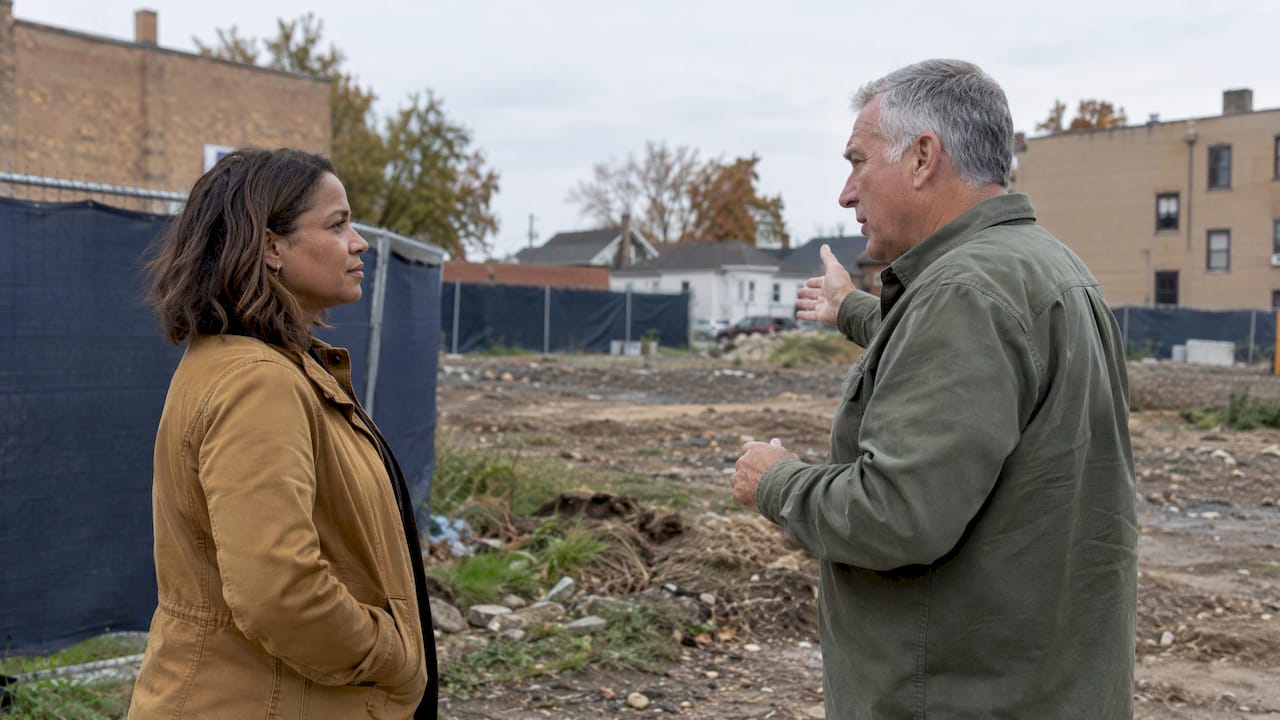
A land use project’s reputation is protected before opposition appears, not after. Teams that begin engagement while real choices remain open, say plainly what can and cannot change, and answer concerns with project-specific facts give critics little to build on. Teams that arrive late with a finished plan give critics the story. This guide covers the practical sequence for developers, local officials, environmental organizations, business owners and nonprofit leaders.
TL;DR
Reputational damage usually starts with late engagement, predetermined outcomes and unclear timelines or constraints, not with a single hostile meeting.
Map who is affected before you design outreach, and look beyond the loudest voices.
Tell people what is open to influence, what is fixed, and why. Hidden agendas cost more credibility than bad news does.
Answer criticism and misinformation with respectful, project-specific facts, then show how input changed the project.
Measure trust over time with surveys and interviews, not just attendance counts.
Table of Contents
1. What actually damages a project’s reputation
Most reputation problems in land use are process problems. The 2026 ULI report on community engagement in real estate development points to three recurring causes of distrust: engagement that begins late, outcomes that look predetermined, and unclear timelines, tradeoffs or constraints.
The same report frames community distrust as something that can be grounded in past exclusion and a lack of visible results from earlier projects. That changes how a team should read a skeptical room. A resident who doubts your sincerity may be reacting to what happened the last time someone promised to listen, not to your project at all.
Three patterns show up again and again:
The surprise. Neighbors learn about the project from a legal notice, a sign or a rumor. Whatever you say next is read as damage control.
The staged meeting. People are invited to comment on a design that is already final. Oregon’s Putting the People in Planning guide warns that hiding how much influence the public has, or whether an outcome is already preferred, damages credibility.
The vacuum. When the project team is silent between milestones, opponents, social media groups and competing narratives fill the space.
If one of these describes your situation, the fix is the same: move engagement earlier, make influence explicit and keep communicating on a predictable schedule.
2. Start with a situation assessment
Before planning any meetings, find out who is affected and what they care about. The U.S. EPA’s Public Participation Guide on situation assessments describes a straightforward sequence. Begin with an internal review of the decision to be made, who holds authority, and which constraints are fixed. Then interview known community stakeholders and ask each one who else is affected or should be consulted.
The assessment should surface the key voices, their concerns, the opportunities for public input and the constraints, all before the engagement process is designed. Useful questions for each interview include:
What are your main concerns and priorities about this project?
Where do you get information you trust?
How would you prefer to participate?
Who else should we be hearing from?
Map stakeholders in layers
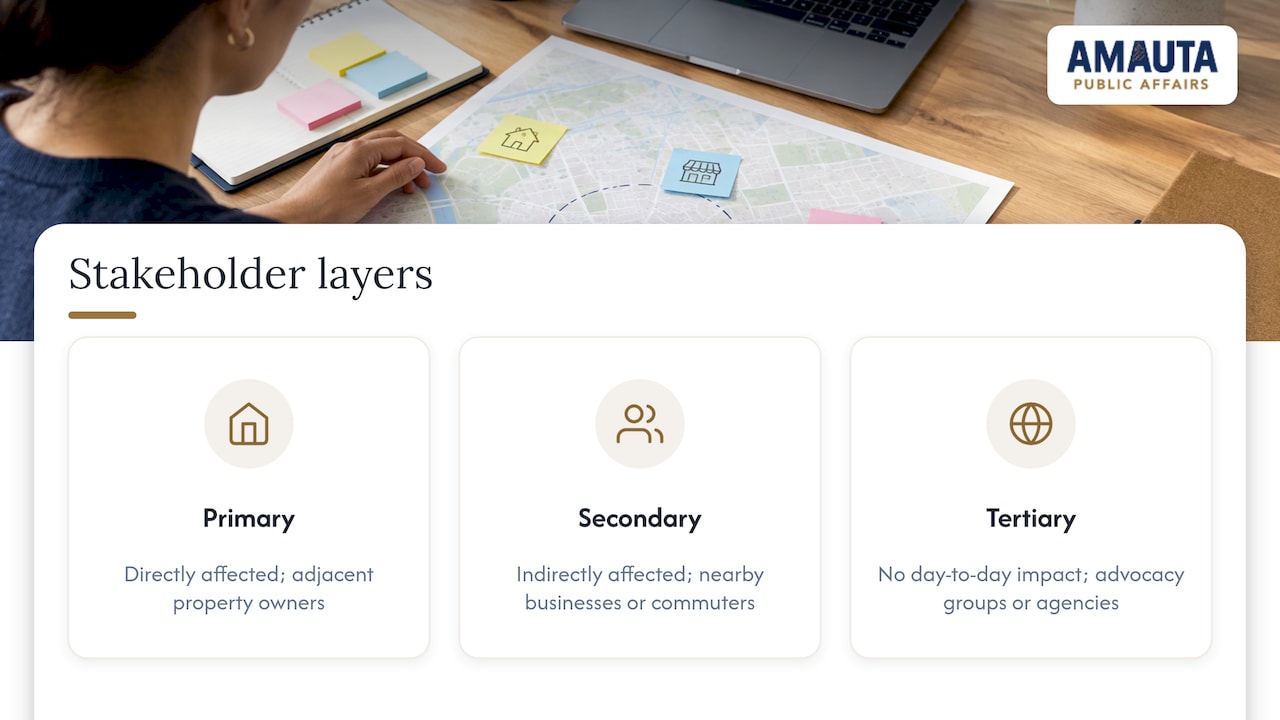
The City of Raleigh’s Community Engagement Process Development Playbook offers a simple model. Primary stakeholders are directly affected, such as adjacent property owners. Secondary stakeholders are indirectly affected, such as nearby businesses or commuters. Tertiary stakeholders have an interest in the outcome without living with it day to day, such as advocacy groups or regional agencies.
The playbook also recommends identifying hard-to-reach groups with local input, including renters, immigrants, people with disabilities, limited-English speakers, Indigenous groups, seniors, youth and people outside organized groups. These are the residents most often missed by a notice in the newspaper and a hearing on a weekday evening.
Do not mistake volume for consensus
The EPA’s Module 4 participation workbook cautions that the loudest or most visible stakeholders do not necessarily represent the whole community, so organizers should actively seek a range of perspectives. A reputation built only on the opinions of the people who showed up is fragile, because the quiet majority can turn out later, at the vote.
For a deeper look at how this fits into a project plan, see our guide to the role of a community engagement strategy in projects.
3. Engage before the decisions are fixed
Timing is the most protective variable you control. The ULI report recommends beginning engagement before formal planning so teams can understand priorities and concerns while meaningful project choices remain available. The Udall Foundation’s principles for stakeholder engagement in infrastructure similarly call for identifying project goals, schedules, engagement opportunities and the sponsor’s commitment from the earliest stage.
In practice, an early engagement plan has four parts:
A stated purpose. What decision is the community helping to shape? The EPA workbook recommends focusing participation on issues that matter to the community and where public input can actually influence the outcome.
A predictable schedule. The Udall principles recommend predictable engagement schedules and multiple ways to take part, so people are not forced into a single meeting time or format.
Two-way dialogue. The New Mexico DOT’s public involvement guide recommends open-ended input, substantial time for questions and a clear explanation of which project phase you are in.
A feedback loop. The same guidance calls for reporting back on how input was considered and demonstrating visible changes where appropriate.
That last point is the one most teams skip. People forgive a “no” with a reason far more readily than they forgive silence. Our article on stakeholder communication strategies for land use projects goes into the cadence of updates in more detail.
4. Say what is open and what is not
Credibility comes from candor about limits. If the site is fixed by ownership but the access road, buffer and landscaping are open, say exactly that. If a zoning designation constrains height, name the rule. The ULI report stresses that engagement must make the community’s influence and the project’s constraints clear.
A one-page “what you can influence” sheet works well. Divide it into three columns: decisions already made (with the reason), decisions open for input (with the deadline), and decisions that belong to another authority, such as the planning commission or a state agency. When a step belongs to an authority, say so, and explain how the public can reach it.
5. Communicate benefits, impacts and tradeoffs credibly
A project that only describes benefits sounds like marketing. The International Finance Corporation’s information disclosure guidance recommends timely, objective information in an understandable format that explains both benefits and disadvantages, acknowledges uncertainties, says which elements are fixed or open to change, and allows time to consider the material before consultation begins.
Several federal documents offer practical standards you can borrow:
The Bureau of Land Management’s 2024 socioeconomic desk guide recommends explaining cause-and-effect relationships, grounding analysis in current science, and using visual communication and plain language.
The Department of Energy’s NEPA recommendations say the impacts of alternatives should be presented comparatively, with enough information for readers to judge the differences and without bias for or against any alternative.
The 2023 transmission siting practices report recommends sharing information on routing, property impacts, compensation, construction timing, safety and the approval process, and considering design or route changes where feasible.
The IFC guidance adds that information should be tailored to stakeholders’ language, literacy, culture and preferred channels, rather than delivered in one format for everyone. A 40-page technical appendix does not serve a resident who reads mostly in Spanish and gets news from a neighborhood group chat. A translated one-page summary, a map and a short video might.
A worked example: a developer proposing a mixed-use building near a residential street hears that neighbors fear traffic. A generic reply (“we will manage traffic responsibly”) fails. A better reply names the study, shows the projected change on that street by hour, states what the team will do about delivery routing, and says which mitigation measures neighbors can still weigh in on. The specificity is the reputation protection.
6. Respond to criticism and misinformation without escalating
Opposition is not the same as a reputation problem. Organized opposition becomes a reputation problem when your response looks evasive, defensive or dishonest. Two principles hold up across the guidance.
Answer the actual concern with project facts. The transmission siting report says concerns about property values, health, burial, project need and local benefits should be heard and answered with project-specific information rather than generic responses.
Correct inaccurate claims respectfully, truth first. The Clean Air Task Force’s 2026 guidance, “There’s No Substitute for Trust”, recommends leading with the accurate information rather than repeating the false claim, responding respectfully, following up on concerns, and showing how input affected the project.
A practical response routine:
Log the claim and where it is spreading, including social channels and local news.
Decide whether it is a misunderstanding, a disagreement or a legitimate concern you have not yet addressed.
Reply in the same channel with the facts, a source and a named contact.
Follow up privately with the people who raised it, and report back publicly on what changed.
Monitoring is the prerequisite. You cannot respond to what you cannot see, which is why systematic listening matters; our practical guide to social listening for public affairs explains how teams track local conversation. For the broader principle that openness and proactive engagement safeguard credibility, this step-by-step approach to managing online reputation is a useful complement to the project-specific work above.
7. Measure whether trust is improving
Meeting counts and sign-in sheets tell you who came, not whether anyone believes you. The ULI report recommends evaluating engagement with both quantitative and qualitative evidence and warns that event and attendance counts alone do not show whether people felt heard or whether their input mattered.
A workable scorecard combines:
Signal | How to gather it | What it tells you |
Trust and process fairness | Repeated short surveys and interviews, same questions each round | Whether perceptions are moving over time |
Sustained participation | Returning attendees, not only new ones | Whether people find the process worth their time |
Quality of dialogue | Notes on whether questions are constructive or adversarial | Whether the relationship is shifting from conflict to problem solving |
Community advocacy | Residents or groups speaking up for the project | Whether trust has become public support |
Visible influence | A log of input received and the decision it affected | Whether the “you said, we did” loop is real |
Compare results over time, and keep assessing through construction and operation. A project’s reputation is tested again when trucks arrive and when the facility opens.
8. Why a campaign-style approach protects reputation
The sequence above is straightforward to describe and demanding to execute. It means interviewing stakeholders, producing materials in several formats, monitoring conversation, responding quickly and recalibrating as feedback arrives, all while the permitting clock runs. Teams that treat it as a side task for a project manager tend to fall back on notices and a single hearing.
That is the gap a campaign-style approach is built to close. Treating community support as a campaign means setting priorities from an assessment of the local landscape, tailoring messages to each audience, and adjusting tactics as real-time feedback comes in. Our related guides on improving public perception of a commercial project and transparent communication in business development plans show how those pieces fit together, and our look at permitting public outreach explains why notification alone is not enough.
9. Our perspective
We approach reputation as something a project earns in the community’s eyes through its process, not something it announces. Every land use challenge has its own mix of stakeholders, history and constraints, so we begin with a meticulous evaluation of the community landscape before we propose a single tactic. What we see as the prerequisite is honesty about the decision itself: what is open, what is fixed and who decides. From there, community engagement, media relations and digital advocacy work together, and coalition building brings credible local voices into the conversation. Our tactics are refined continuously based on real-time feedback, because a plan written in month one rarely survives contact with a community in month four. We also believe measurable results matter. Trust is not a feeling to be assumed; it is something to track and improve, which is why our approach integrates data-driven analysis with relationship building. Done well, that discipline moves a project from defending itself to having neighbors, local officials and partners who speak up for it. Ignacio
10. Where AMAUTA fits
AMAUTA Public Affairs supports developers, local governments, business owners, nonprofits and environmental organizations on land use, energy, infrastructure and commercial development projects. Our services include community engagement, media relations, digital advocacy, coalition building, stakeholder relations, permitting support, supporter turnout and campaign management, each shaped around the specific project. You can review the full list on our services page, or get in touch to talk through where your project stands.
If you are weighing outside support, our overview of what community engagement services include and how to choose is a good place to start.
FAQ
When is it too late to start protecting a project’s reputation?
It is rarely too late to improve, but the cost rises as choices are locked in. The ULI report recommends starting before formal planning so that meaningful options remain open. If you are already in opposition, begin with a situation assessment, state clearly what can still change and show quickly that input is being used.
Should we respond to every critic or false claim?
Not every comment needs a reply, but claims that are spreading among residents or local media do. Lead with the accurate, project-specific facts, stay respectful and name a contact. Concerns that are legitimate deserve a follow-up and, where feasible, a visible change.
How do we reach residents who never attend meetings?
Ask them how they want to participate. Raleigh’s playbook points to renters, limited-English speakers, seniors, youth and people with disabilities as groups often missed, and recommends using local input to identify and reach them. Offering several formats, times and languages is the practical answer.
What does a good reputation metric look like?
One that tracks perceptions over time. Repeated surveys or interviews on trust and fairness, sustained participation and evidence of input shaping decisions say far more than a count of attendees.
Sources
ULI: Best Practices for Community Engagement in Real Estate Development (2026)
City of Raleigh: Community Engagement Process Development Playbook
Udall Foundation: Principles for Effective Stakeholder Engagement in Infrastructure
Department of Energy: Recommendations for Environmental Assessments
Recommended Siting Practices for Electric Transmission Developers (2023)
Clean Air Task Force: There’s No Substitute for Trust (2026)
Recommended
Comments