
Public Information Campaigns for Land Use Projects
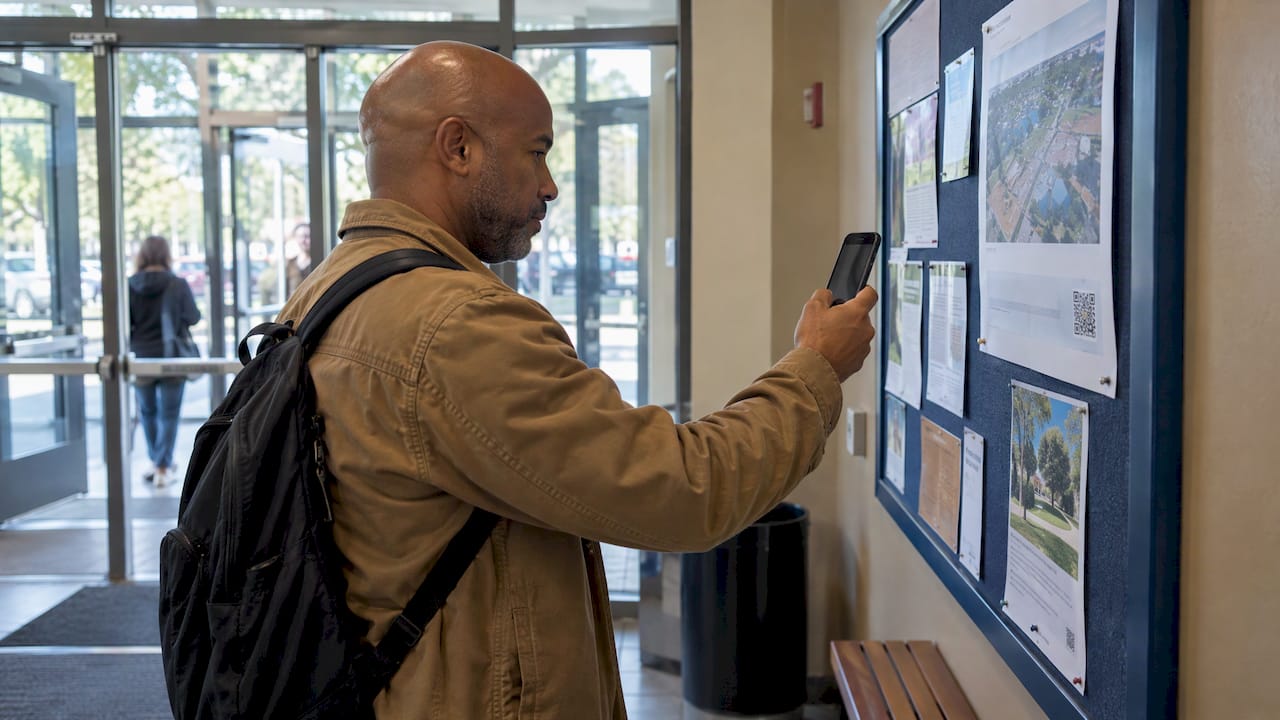
A public information campaign is an organized, time-limited effort to give a large audience the facts it needs about an issue, and, for a land use project, to bring that audience into the decision. The campaigns that work share a pattern: clear objectives, audiences identified early, plain-language messages, channels chosen for where people already are, and measurement that changes the plan mid-course. We treat a project as a campaign from day one, because a permit hearing is a poor place to meet your community for the first time.
TL;DR
A public information campaign informs a large audience for a defined period to reach a specific outcome. In land use, that outcome is usually informed participation in a decision.
Start with objectives and a baseline of who lives, works and votes around the site, then segment audiences instead of writing one message for everyone.
Test every message against one question: why should this person care? Then pick channels based on where they already gather.
Measure reach, understanding and participation, report back what you heard, and adjust while the campaign is still running.
Vocal opposition is not always the majority view, so verify who the public actually is before you respond.
Table of Contents
What a public information campaign is
The classic definition comes from communication scholarship. Kopfman and Ruth-McSwain describe public information campaigns as government-sponsored efforts to address social problems by communicating information to large numbers of citizens, with the aim of raising awareness, changing attitudes, motivating behavior and, at times, affecting policy. Matusitz adds a useful structure: a comprehensive, organized, strategic attempt to shape behavior, attitude or decision-making within a community over a specific time limit, in which a first phase builds awareness and a second uses that awareness to change behavior.
For a developer, city planner, environmental group or nonprofit, the translation is practical. Awareness is the prerequisite, not the goal. Residents who know a project exists, understand what it changes for them and see how to comment are in a position to participate. Residents who first hear about it from a rumor are not.
That also separates a campaign from a single notice or press release. Publicity pushes a message out once. A campaign sets objectives, sequences messages, listens and adjusts. Public engagement, the two-way part, is what the information phase prepares for. Good programs run them together.
Why land use projects need more than notice
Legal notice tells people a hearing exists. It rarely tells them why the project matters to their street, their commute or their water. We have written about why permitting outreach must do more than notify, and the underlying logic is simple: a project team that treats outreach as a compliance checkbox leaves the story to whoever speaks first and loudest.
The evidence on that risk is concrete. A peer-reviewed study of the Forsythe II fuels treatment in Colorado found that 27% of surveyed households opposed the project, 31% supported it and 28% had no opinion. Yet 56% had rarely or never taken part in Forest Service comment opportunities, and 66% did not know whether input had changed anything. The visible conflict did not describe the community. A campaign that reaches the quiet middle changes the conversation.
Two public-sector examples worth studying
Redesigned community updates in California
California’s Office of Data and Innovation worked with the Department of Toxic Substances Control on three pilot cleanup projects. The team rewrote Community Updates in plain language, made them mobile-first with QR codes and added sponsored social posts. According to the state’s project write-up, the pilot more than quadrupled the average public comment rate, 81% of comments arrived by mobile, 68% were in Spanish, and social media reached 30,000 Californians. The lesson is that format and language were the barriers, not apathy.
Youth capacity in land use planning
The state’s Land Use Planning Awareness Project spent about ten months building youth skills in planning at NOVA Academy. The students then produced a photovoice project, presented at Health Impact Assessment workshops for the 50-mile Coachella Valley Link trail, with results added to the public record. Informing a group that is usually absent from planning produced input the formal process would have missed.
Set objectives and know the community first
Oregon’s planning guide advises stating public involvement objectives clearly, including how decisions will be made and how people can give input, and identifying audiences early. Its core plan elements include a study area map, the project’s purpose and outcomes, a decision-making timeline, communication protocols covering inquiries and media relations, outreach materials and strategies for each target audience.
The City of San Diego’s Inclusive Public Engagement Guide offers a compact eight-step sequence worth borrowing:
Plan resources.
Collect baseline data.
Identify stakeholders.
Determine the level of participation.
Develop communication materials.
Create and implement an engagement plan.
Report back.
Evaluate the process.
Two steps deserve emphasis. Baseline data, meaning who lives nearby, what languages they speak and what concerns have already surfaced, is what makes later measurement meaningful. And determining the level of participation forces an honest answer to a question that sinks many campaigns: can the public actually influence this decision, and how much?
Segment your audiences
Atkin and Rice recommend audience segmentation so content, form, style and channel fit each subgroup. They also argue that indirect audiences, such as interpersonal influencers and policy makers reached through media advocacy, can produce greater impact than persuading individuals directly. In a land use setting, that means neighbors, business owners, faith and civic leaders, local reporters and elected officials each need a different entry point into the same facts.
Oregon suggests meeting people where they already gather, such as churches and activity centers. A project team that waits for people to come to a hearing has chosen the narrowest possible audience.
Our community engagement strategy overview and stakeholder communication guide go deeper on mapping those groups.
Write messages people can use
The test comes from Oregon’s equitable engagement toolkit: can a community member quickly answer why this project is relevant to them and why they should care? The same toolkit recommends plain language at a fifth-grade reading level, jargon-free and multilingual materials, and a mix of channels: email, websites, newsletters, posters, flyers, social media, direct mail, and text, phone and in-person outreach.
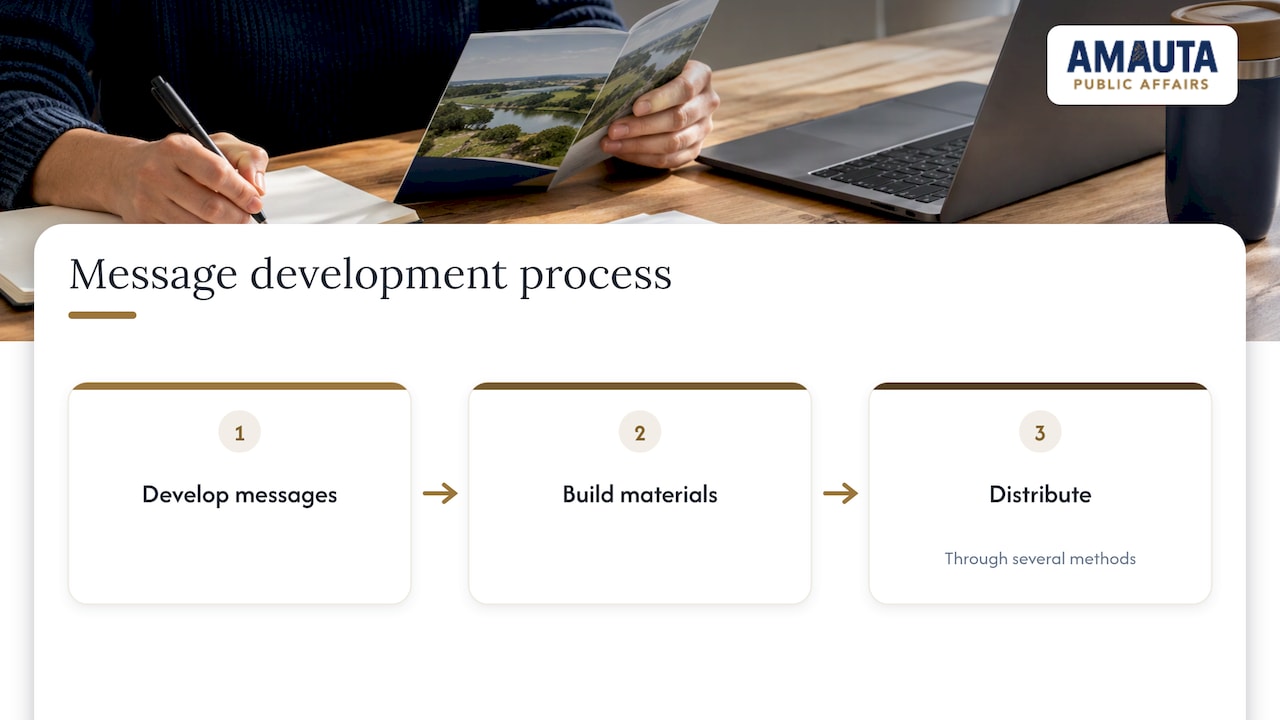
San Diego’s guide breaks the work into three steps: develop key messages, build materials from them and distribute through several methods. Its key messages state why the project matters and how the public can participate.
The U.S. Fish and Wildlife Service frames messaging as four problems: content (what to say), structure (the logical order), format (how to say it symbolically) and source (who should say it). Its habitat conservation handbook adds that communicators should agree on what needs to be said before spending money on channels. The source question is often decisive in land use work: a message about a new facility lands differently from a trusted local voice than from the applicant alone. That is the logic behind coalition building and supporter turnout.
Keep message discipline in a social media environment
Zhao’s review of health communication campaigns lists four consensus tasks: set objectives, develop message strategies, disseminate through appropriate channels and conduct systematic research to inform and evaluate. It also cautions that on social platforms audiences can redefine, repost or parody messages, so campaigns need monitoring and nimble adjustment to protect message fidelity. Overexposure can backfire as well, which is another reason to plan frequency instead of simply maximizing volume.
Connect information to real engagement
Information campaigns fail when they feel like a sales pitch with no door to walk through. The FWS handbook describes a continuum from providing information, to soliciting it, to facilitating shared decision-making. Its channels include newsletters and websites, personal contact with stakeholders (logged), formal public comment and public meetings or open houses.
The practical rule is to match the channel to the level of influence you are offering. If the decision is already made, say so and explain what remains open. Oregon’s guide is blunt on this point: be crystal clear about the public’s ability to influence decisions, listen for interests rather than positions, say “I don’t know” and follow up, and admit when you are wrong. Trust, it notes, is fragile and easy to lose, and honest disclosure is the best way to protect credibility.
Measure, report back and adjust
Measurement starts with the objectives, not the dashboard. Oregon’s toolkit lists participation metrics: total participants, how they learned about opportunities, format, voluntary demographics, language groups and community affiliations. Its evaluation options include feedback surveys, focus groups, interviews and internal team debriefs.
Salt Lake City’s guide adds discipline on process: record feedback verbatim, include demographic questions, allow at least two weeks to analyze data before decisions and report back to participants on what was heard and how it influenced the outcome.
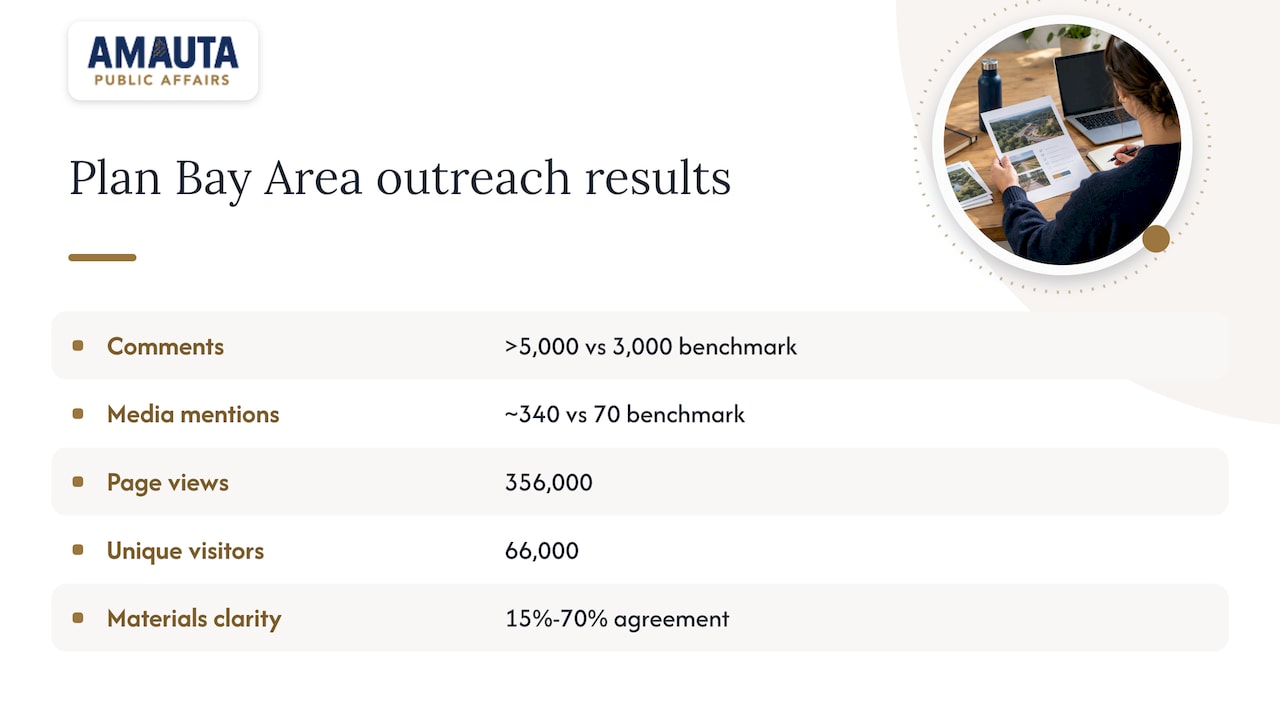
A worked benchmark comes from the Bay Area. The evaluation of the Plan Bay Area outreach program (2010 to 2013) recorded more than 5,000 comments against a 3,000 benchmark, about 340 articles and opinion pieces against a benchmark of 70 media mentions, and 356,000 page views from 66,000 unique visitors on its website. The same evaluation found that agreement on whether materials were clear ranged from 15% to 70% across workshops, and a redesigned open-house format followed. Counting outputs is only half the job; the clarity scores are what drove a change.
For behavior or environmental outcomes, set realistic horizons. EPA’s watershed outreach guide recommends comparing audience attitudes before and after a program, and notes that true impact on water quality can take seven to ten years to detect. Short campaigns should therefore track leading indicators such as awareness, understanding and participation.
Online indicators need the same care. A guide to website success metrics and tools can help you define which traffic and engagement numbers matter for a project page. Our own piece on campaign performance measurement for land use projects applies these ideas to the project setting.
Common failure points and how to avoid them
Problem | What it looks like | Practical response |
Loudest voices stand in for the community | Hearings dominated by a small group | Survey or sample the wider community before drawing conclusions, as the Forsythe II study showed |
Jargon-heavy materials | Low comment rates, confusion at meetings | Plain language, tested against the question of why the reader should care |
One channel | Only hearing attendees respond | Mix print, mobile, in-person and social, matched to each audience |
No visible follow-through | Residents unsure whether input mattered | Report back on what was heard and what changed |
Message drift | Reposted or reframed content online | Monitor and adjust quickly |
Most of these are planning failures, not communication failures. They are far cheaper to prevent in the first month than to repair after opposition has hardened.
How AMAUTA supports public information campaigns
AMAUTA Public Affairs takes a campaign-style approach to land use, energy, infrastructure and commercial development projects. Our services include community engagement, media relations, digital advocacy, coalition building, branding and marketing, stakeholder relations, permitting support, supporter turnout and campaign management. We tailor strategy to each project’s community landscape and refine tactics based on real-time feedback.
If you are a developer, local government, nonprofit or business planning a project, see the full list of services or get connected with our team.
Our perspective
Most land use conflicts we study did not begin with the project. They began with a silence before it. People filled the gap with whatever they heard first, and by the time a formal process started, positions had hardened. We believe a public information campaign is the pathway to implementation, not decoration around it. It starts with a granular read of the community landscape, moves through strategic messaging that answers why a neighbor should care, and keeps adjusting as feedback arrives. That is why our work is built like a campaign: priorities set early, tactics refined continuously, results tracked against the objectives. The public sector guides cited above agree on the essentials: be honest about influence, reach people where they already are, and report back. Teams that do this well earn trust that outlasts a single approval, and that trust is the asset that makes the next project possible. Ignacio
FAQ
What is the difference between a public information campaign and public engagement?
A public information campaign focuses on getting accurate information to a large audience over a set period, building awareness so people can act. Engagement is the two-way work of gathering input and, at the highest levels, sharing decisions. In land use, the two should be planned together so information leads naturally into participation.
How long should a land use information campaign run?
It should span the decision timeline, from early awareness through the final decision and the report back. Salt Lake City’s guidance, for example, allows a minimum of two weeks for analysis before decisions, so build that time into the schedule rather than treating it as a bonus.
Which channels work best for reaching residents?
No single channel does. Oregon’s toolkit lists email, websites, newsletters, posters, flyers, social media, direct mail, and text, phone and in-person outreach, and the California cleanup pilot saw 81% of comments arrive by mobile. Choose channels per audience, and use multilingual materials where your community needs them.
How do you know whether a campaign is working?
Track the objectives you set at the start: participant counts, how people heard about the project, language and demographic reach, clarity ratings and media coverage. Compare them with benchmarks, as the Plan Bay Area evaluation did, and change formats mid-course if the numbers or feedback call for it.
Sources
Public Information Campaigns, Kopfman and Ruth-McSwain (2021)
Fundamentals of Public Communication Campaigns, Matusitz (2022)
Lifting Californians’ voices in toxic substance cleanup project decisions
Theory and Principles of Public Communication Campaigns, Atkin and Rice
Habitat Conservation Planning Handbook, Chapter 4, U.S. Fish and Wildlife Service
Health communication campaigns: A brief introduction, Zhao (2020)
Getting In Step: Guide for Conducting Watershed Outreach Campaigns, EPA
Recommended
Comments