
Two Year Permit Battles? Public Affairs vs PR for Practitioners

Public relations builds commercial reputation with customers and media; public affairs builds influence with regulators, policymakers, and community stakeholders. Government relations and lobbying sit inside public affairs as a narrower, regulated slice of that broader discipline. The rest of this piece breaks the distinction into the specifics that determine which one your organization actually needs.
TL;DR:
Public affairs focuses on building relationships with regulators, officials, and community groups to influence policy and secure permits, often over years.
Public relations targets consumers and media to boost brand recognition, with success measured in media impressions and sentiment within weeks or months.
Effective coordination requires shared messaging, clear role assignment, and rapid review to prevent conflicting statements during policy or public engagement campaigns.
U.S. lobbying activity is regulated and requires disclosure, while broader public affairs efforts like community outreach usually do not, making legal consulting vital.
The right discipline depends on whether the objective is regulatory approval and stakeholder coalition building or brand promotion and media coverage.
Table of Contents
Public Affairs vs. PR at a Glance
The fastest way to see the difference between PR and public affairs is to line up what each discipline optimizes for. PR chases attention and sentiment among buyers and the press. Public affairs chases alignment and permission among the people who can approve, block, or regulate a project.
Primary audience: PR targets customers, consumers, and media outlets; public affairs targets regulators, elected officials, community groups, and coalition partners.
Main goal: PR builds brand recognition and commercial reputation; public affairs shapes policy outcomes and stakeholder consent.
Typical tactics: PR relies on press pitching and product storytelling; public affairs relies on stakeholder mapping, testimony, and coalition building.
Time horizon: PR often runs on launch cycles measured in weeks or months; public affairs campaigns commonly span the length of a permitting or legislative process, sometimes years.
Success metrics: PR tracks media impressions and sentiment; public affairs tracks stakeholder alignment, permit approvals, and votes secured.
A concrete example makes it stick. A company launching a new energy storage product uses PR to land trade press coverage and build buyer trust. If that same company needs a zoning variance to build the facility, public affairs takes over, mapping the county commission, neighborhood associations, and state regulators who decide whether the project happens at all.
What Do PR and Public Affairs Actually Do?
Public relations is the discipline of managing an organization’s reputation with customers, media, and the general public through earned coverage, brand storytelling, and reputation defense. Public affairs is the discipline of managing an organization’s standing with regulators, elected officials, and community stakeholders to influence policy decisions and secure public consent for a project or position.
The audiences overlap at the edges but diverge at the core:
PR-primary audiences: journalists, trade media, consumers, investors focused on brand perception, and social media followers.
Public-affairs-primary audiences: local and state regulators, elected officials, community and neighborhood groups, industry coalitions, and permitting bodies.
Shared audiences: local news outlets, which both functions court, but for different reasons, and employees, who need consistent messaging from both sides.
The core difference comes down to relationship type: PR builds commercial relationships that drive sales and brand equity. Public affairs builds political and civic relationships that determine whether a project gets built at all.
How Do You Measure Success in Each Field?
PR success shows up in media impressions, share of voice, sentiment scores, and campaign reach. A launch that generates hundreds of press mentions and a favorable sentiment shift counts as a win by PR’s own scorecard.
Public affairs success looks different because the outcomes it targets aren’t commercial. A win means a permit approved, a zoning variance granted, a coalition of ten community groups signed on in support, or a piece of legislation amended before a final vote.
Statistic Callout: Stakeholder alignment and coalition strength function as public affairs’ equivalent of PR’s reach and sentiment metrics. Reporting on the wrong scorecard, tracking media hits for a permitting fight or counting votes secured for a product launch, misleads leadership about whether the underlying goal is actually being met.
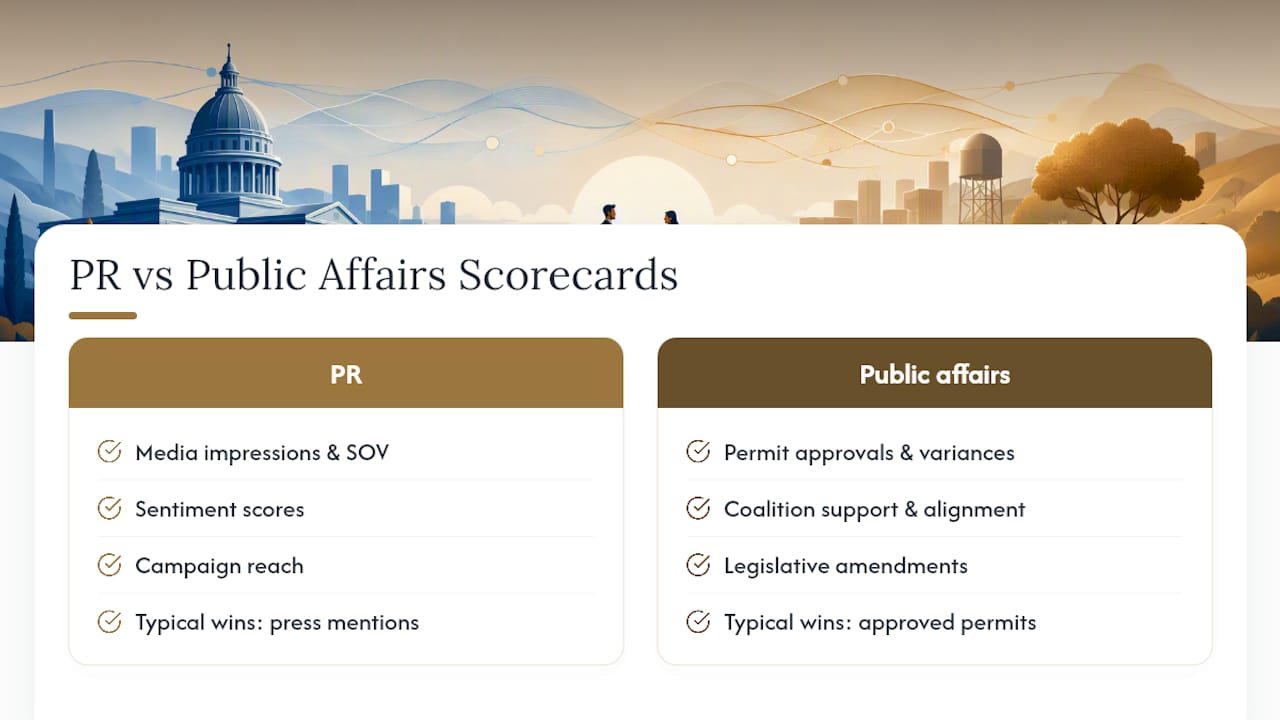
Time horizon reshapes the metrics too. A 90-day PR campaign reports weekly impressions. A two-year permitting campaign reports quarterly on stakeholder sentiment shifts, meeting attendance, and coalition growth, since the final vote may not happen until year two.
Which Tactics Does Each Discipline Use?
PR practitioners spend their time pitching journalists, coordinating influencer partnerships, managing crisis communications, and orchestrating product launches. The toolkit is built for speed and reach: a press release, a media exclusive, a rapid response statement.
Public affairs practitioners work a slower, more relational toolkit. Their core activities include stakeholder mapping, policy monitoring, and preparing executives with disciplined messaging well before any decision point arrives.
PR tactics: media pitching, influencer partnerships, crisis response, product launch events.
Public affairs tactics: stakeholder mapping, policy briefs, legislative testimony, coalition building, digital advocacy, and permitting support.
Shared channels: both use social media and local press, but PR chases reach while public affairs uses the same channels to build credibility with specific decision makers.
Pro Tip: If your team is running digital ads or community outreach that touches an active policy decision, agree on message control and approval steps before launch. Digital advocacy tools blur the line between PR and public affairs fast, and a mismatched message to a regulator can cost more credibility than a slow rollout ever would.
Who Handles Each Function Inside an Organization?
PR typically reports through a communications director or VP of communications, with specialists like media relations managers and content leads underneath. Public affairs usually reports through a government relations director, VP of public affairs, or, in larger organizations, a chief public affairs officer, with government relations managers and community engagement specialists on the team.
PR sits closer to marketing and the C-suite communications function.
Public affairs sits closer to legal, government relations, and sometimes the CEO’s office directly, given the regulatory stakes.
The two teams should share a weekly sync and a single message matrix so a policy statement never contradicts a brand statement made the same week.
How Do the Two Teams Coordinate Without Crossing Wires?
An integrated campaign for a controversial development project needs both functions working from the same script. Public affairs leads community meetings and regulatory testimony while PR handles press inquiries and brand messaging, but both pull from one shared narrative.
Assign a lead by decision type. Public affairs leads anything touching a regulator, permit, or elected official; PR leads anything touching a customer, investor, or general audience.
Build one shared message matrix. Every talking point gets approved once, then both teams pull from the same document instead of drafting in isolation.
Set a rapid escalation rule. Any statement that could affect a pending permit or vote gets a same-day review by both team leads before it goes out, because treating public affairs as a reactive afterthought tends to produce mixed messaging exactly when consistency matters most.
Where Does Lobbying Fit, and What Do U.S. Rules Require?
Government relations is the narrowest piece of this puzzle: direct engagement with legislators and regulators to shape a specific bill, rule, or vote. Public affairs is the broader strategic function that includes government relations plus media relations, community outreach, and long-term reputation management.
In the United States, lobbying activity is subject to disclosure under the Lobbying Disclosure Act, while broader public affairs work carries no equivalent federal registration requirement. That gap matters operationally.
Direct contact with a legislator or staffer to influence specific legislation can trigger registration thresholds under the Act.
General community engagement, coalition building, and media outreach typically fall outside that registration regime.
When in doubt about whether a specific contact crosses into regulated lobbying, consult legal counsel before the conversation happens, not after.
Blurring lobbying and public affairs in strategy documents often leads organizations to either under-register when they should or waste lobbying-grade resources on activity that never needed it.
When Should You Hire Public Affairs, PR, or Both?
Start with the job that needs doing, not the label on the org chart.
Facing a permit, zoning, or regulatory decision? Hire public affairs, and hire it early, since stakeholder relationships built before a policy window opens carry far more weight than relationships built during a crisis.
Launching a product or defending brand reputation? Hire PR.
Both a launch and a regulatory hurdle at once? Run both disciplines in parallel with one shared message matrix, not one team wearing two hats.
Interviewing an agency or candidate? Ask specifically how they measure success, what stakeholder mapping process they use, and whether they’ve handled a permitting fight or legislative session, not just a media campaign.
How AMAUTA Public Affairs Runs a Campaign-Style Engagement
AMAUTA Public Affairs treats each land use or infrastructure project as its own campaign rather than applying a standard template. That starts with an assessment of the community landscape, identifying which stakeholders, neighborhood groups, and regulatory bodies will decide a project’s fate before a single message goes out.
Stakeholder mapping identifies supporters, opponents, and undecided voices early, so outreach targets the people who actually influence the outcome.
Tactics get recalibrated continuously based on real-time feedback from community meetings, digital engagement, and media coverage, rather than running a fixed plan for months.
Media relations work integrates directly with the broader campaign, so press coverage reinforces the same messaging used in community meetings and permitting testimony.
Digital advocacy and supporter turnout tools extend the campaign’s reach without losing message discipline across channels.
This is where PR-style media work and public-affairs-style stakeholder engagement genuinely converge: the same campaign narrative shows up in a news story, a community meeting, and a permit hearing.
Choosing the Right Discipline Comes Down to the Job, Not the Job Title
The mistake I see most often is organizations hiring PR to solve a permitting problem, or hiring a lobbyist to fix a reputation crisis. Match the discipline to the actual decision maker you need to move: journalists and customers call for PR; regulators, officials, and community stakeholders call for public affairs. AMAUTA Public Affairs works with organizations facing that second challenge.
— Ignacio
Sources
FAQ
Is Public Affairs the Same as Government Relations?
No. Government relations is a narrower subset of public affairs focused specifically on direct engagement with legislators and regulators. Public affairs also includes media relations, community outreach, and coalition building that support those government-facing efforts.
Which Is Better, HR or PR?
These are different functions entirely and can’t be compared on a single scale. HR manages people and workplace policy inside an organization, while PR manages external reputation and media relationships, so the better fit depends entirely on which problem you’re solving.
Is Public Affairs a Stressful Job?
Public affairs work can be demanding because outcomes often hinge on regulatory timelines, political shifts, and community sentiment that the practitioner doesn’t fully control. The longer time horizons and higher stakes compared to a typical PR launch cycle add pressure, but many practitioners find the policy impact rewarding.
Is “PR” the Same as “Public Relations”?
Yes, “PR” is simply the common abbreviation for public relations, the discipline focused on commercial reputation, brand recognition, and media relationships. It’s a different function from public affairs, which centers on policy and regulatory influence rather than brand building.
Recommended
Comments