
Treat Permitting Like a Campaign: U.S. Variance Approval Strategy

The single most effective variance approval strategy is to treat the request as an approval roadmap, not a paperwork exercise: map stakeholders, confirm the statutory findings your case must satisfy, pressure-test the application in a pre-application meeting, and surround the technical justification with community outreach and enforceable mitigation. The most urgent gate is procedural. Several jurisdictions reject variance applications outright if a required building-permit review hasn’t happened first. Check with your local zoning office, the Board of Zoning Adjustment, and the municipal application calendar before you draft anything.
TL;DR:
Variance approval strategies should focus on mapping stakeholders, confirming statutory findings, and surrounding technical justifications with community outreach and enforceable mitigation.
Building a strong case requires demonstrating a physical hardship tied to land characteristics, not financial reasons, while attaching evidence like surveys and photos aligned with local language.
The typical variance process takes around 90 days in many jurisdictions, involving pre-application meetings, completeness checks, public notices, hearings, and conditions before permit issuance.
Incomplete applications or missing required pre-approvals often lead to rejection or significant delays, and re-application can be prohibited for up to a year in some areas.
Pre-application meetings and community outreach are more influential than perfecting legal arguments, as political support and stakeholder engagement are critical for success.
Table of Contents
When Do You Actually Need a Variance Approval Strategy?
Not every project needs a variance, and confusing the two main types wastes months. An area variance asks permission to deviate from a dimensional standard: setbacks, lot coverage, height, parking counts. A use variance asks permission to use land in a way the zoning district doesn’t otherwise allow, such as running a small commercial operation in a residential zone.
The distinction changes your entire strategy. Area variances typically go before a zoning board of adjustment and carry a lower evidentiary bar because the underlying use stays consistent with the district. Use variances usually face tougher review, sometimes requiring planning commission input or even legislative body sign-off, because you’re asking for something the community’s own zoning map already ruled out.
Before assuming you need either, run through this self-assessment:
Does the zoning ordinance’s dimensional table (setback, height, coverage, lot size) actually prohibit your design as drawn, or could a redesign avoid the variance entirely?
Is the underlying use permitted in the district, or are you introducing a new use category?
Has a similar variance been granted nearby recently? Local precedent often signals how a board will lean.
Does your site have a genuine physical constraint (irregular shape, steep slope, easement) that a general ordinance couldn’t have anticipated?
If the answer to that last question is no, you’re likely building a weaker use-variance case than you think, and it’s worth revisiting design options before filing.
What Findings Do Boards Require, and How Do You Prove Them?
Zoning boards don’t grant variances because a project would be more profitable or convenient with one. They grant them because state enabling statutes and local ordinances require specific findings, and your entire application should be built backward from those findings rather than forward from your preferred design.
Most U.S. jurisdictions require some version of the following:
Unnecessary hardship or practical difficulty tied to the physical characteristics of the land, not the owner’s finances.
Minimum variance necessary to provide relief. Boards reject requests that ask for more than the site condition justifies.
No substantial detriment to the public good or surrounding neighborhood character.
No special privilege granted to this applicant that similarly situated landowners couldn’t also claim.
Statistic Callout: Many jurisdictions explicitly bar financial hardship as a qualifying basis, and denial can trigger a mandatory waiting period before you’re allowed to try again. Snellville, Georgia enforces a 12-month re-application moratorium after a denial, which turns a rushed first filing into a full year of lost schedule.
A qualifying hardship looks like a steeply sloped rear yard that makes a code-compliant setback physically unbuildable, or a triangular lot from a legacy subdivision plat that leaves no configuration meeting standard dimensional rules. A non-qualifying reason looks like “a smaller building costs more per square foot to operate.” Boards see that distinction every meeting, and staff reports call it out by name.
Build your case around the local ordinance’s exact statutory language, then attach a licensed survey, topographic data, and dated photographs that visually prove the constraint. Findings written into your narrative should mirror the ordinance’s own words wherever your facts genuinely support it. That mirroring makes staff reports easier to write in your favor.
How Long Does the Variance Process Actually Take?
Timelines vary by municipality, project complexity, and how clean your first submission is, but the process follows a consistent sequence almost everywhere in the U.S.
Pre-application meeting. Staff flags likely issues before you spend money on final drawings.
Building-permit gate (where required). New Orleans requires a pre-application building-permit filing and zoning review before a variance request is even accepted; incomplete or premature filings get rejected outright, not delayed.
Completeness review. Staff checks the packet against a checklist before docketing it for a hearing date.
Public notice. Neighbor notification and posted-site signage requirements start their statutory clock.
Public hearing. The board takes testimony, staff presents findings, and a vote occurs, sometimes at the same meeting, sometimes at a follow-up.
Decision and conditions. Approval often comes with conditions attached, not a clean yes.
Compliance and permit issuance. You satisfy conditions, then pull the building permit or certificate of occupancy.
Fairfax County, Virginia reports roughly 90 days from a complete filing to final hearing in typical cases, and that figure is a useful planning benchmark even though every jurisdiction runs its own clock. Seattle’s guidance/land-use–master-use-permit—variance) is blunter about the variables: timeline depends on project complexity, submission quality, public interest, and how many correction cycles your packet triggers, which is precisely why a strong pre-application meeting pays for itself.
Document | Purpose | Typical source |
Property survey | Establishes exact lot dimensions and constraints | Licensed surveyor |
Site plan | Shows proposed structure against setback lines | Architect or civil engineer |
Hardship narrative | Ties physical facts to statutory findings | Applicant or consultant |
Technical studies | Traffic, stormwater, or environmental impact where triggered | Specialized consultants |
Neighbor notice list | Confirms notification radius compliance | Title company or applicant |
Huntsville’s Board of Zoning Adjustment requires notarized application forms, proof of legal standing such as a deed or purchase agreement, and a complete neighbor notification list before it will even schedule a hearing. Skipping any one of these items doesn’t just slow you down; it often restarts the clock entirely.
Building the Tactical Playbook Before the Hearing
A well-documented hardship means nothing if the commissioner who controls the swing vote walks into the hearing room having heard nothing but complaints from three angry neighbors. The technical case and the political case have to be built in parallel, and that’s where most applicants underinvest.
Start by mapping your actual decision-makers: the staff planner reviewing your file, the board or commission members who vote, any council member with informal influence over the outcome, and the neighborhood associations likely to organize opposition or support. Stakeholder mapping isn’t a courtesy step; it determines who you talk to first and what you emphasize with each audience.

The pre-application meeting is your best low-cost intelligence gathering opportunity. Staff will usually tell you, if asked directly, which findings they consider weak in your draft narrative and which conditions they’ll likely recommend regardless of your input. Document every commitment made in that meeting in a follow-up email, because staff turnover and memory gaps are common, and a written record protects you at the hearing.
Community engagement works best when it’s specific and early, not a single required public hearing where opposition organizes for the first time. A few tactics consistently outperform doing nothing:
Host a small, targeted meeting with immediately adjacent neighbors before filing, not after.
Distribute a one-page summary with a site diagram, the specific relief requested, and the mitigation you’re offering.
Use neighborhood trust-building tactics that frame the project’s community benefit alongside the technical justification.
Offer enforceable conditions proactively (landscaping buffers, hour restrictions, lighting limits) rather than waiting for the board to impose them.
Pro Tip: Draft your hardship letter and your outreach one-pager side by side, using identical language for the physical constraint and the mitigation offered. Boards and neighbors both notice when the “official” narrative and the “public” narrative don’t match, and that mismatch reads as spin even when it isn’t.
Sequencing matters too. Where technical studies like traffic or stormwater review can run concurrently with your zoning submission rather than after it, phased permitting coordination prevents a linear bottleneck from adding months to an otherwise ready application.
Why Applications Get Denied and What to Do Next
Denials cluster around a small set of avoidable mistakes. Incomplete packets top the list. Skipping a required building-permit pre-review is another, and it often results in immediate administrative rejection rather than a delay. Leaning on financial hardship instead of a physical site constraint is the third, and it’s the one applicants most often don’t realize is fatal until the staff report says so in writing.
Confirm every checklist item before submission; incomplete filings in cities like New Orleans aren’t reviewed, they’re rejected on sight.
Reframe any argument built on cost or convenience around a genuine physical or dimensional constraint instead.
Budget for a moratorium: some jurisdictions, including Snellville’s 12-month waiting period, bar re-application for a full year after denial.
After a denial, get the written findings, correct the specific deficiency cited, and consider whether an administrative appeal or judicial review is faster than waiting out a moratorium.
How AMAUTA Public Affairs Applies This Roadmap in Practice
AMAUTA Public Affairs builds the stakeholder map, the messaging, and the outreach calendar into a project’s approval strategy from day one rather than after opposition surfaces. That means running an approval risk assessment early, identifying which commissioners or neighborhood groups are likely to swing the outcome, and targeting outreach accordingly. Not every project needs outside help. Complex use variances, contested sites, or projects with prior community friction usually benefit from a consultant who can run media relations and community engagement as a coordinated campaign rather than a checklist.
The Part Nobody Tells You About Winning a Variance
Most guidance on variance approval treats the hearing as the finish line, when it’s really a formality that ratifies decisions already made in the weeks before. The applicants who lose usually had a technically defensible hardship argument. They lost because nobody in the room had heard from them before that night, and the loudest voice in the room was opposition that organized while the applicant was still finalizing survey exhibits.
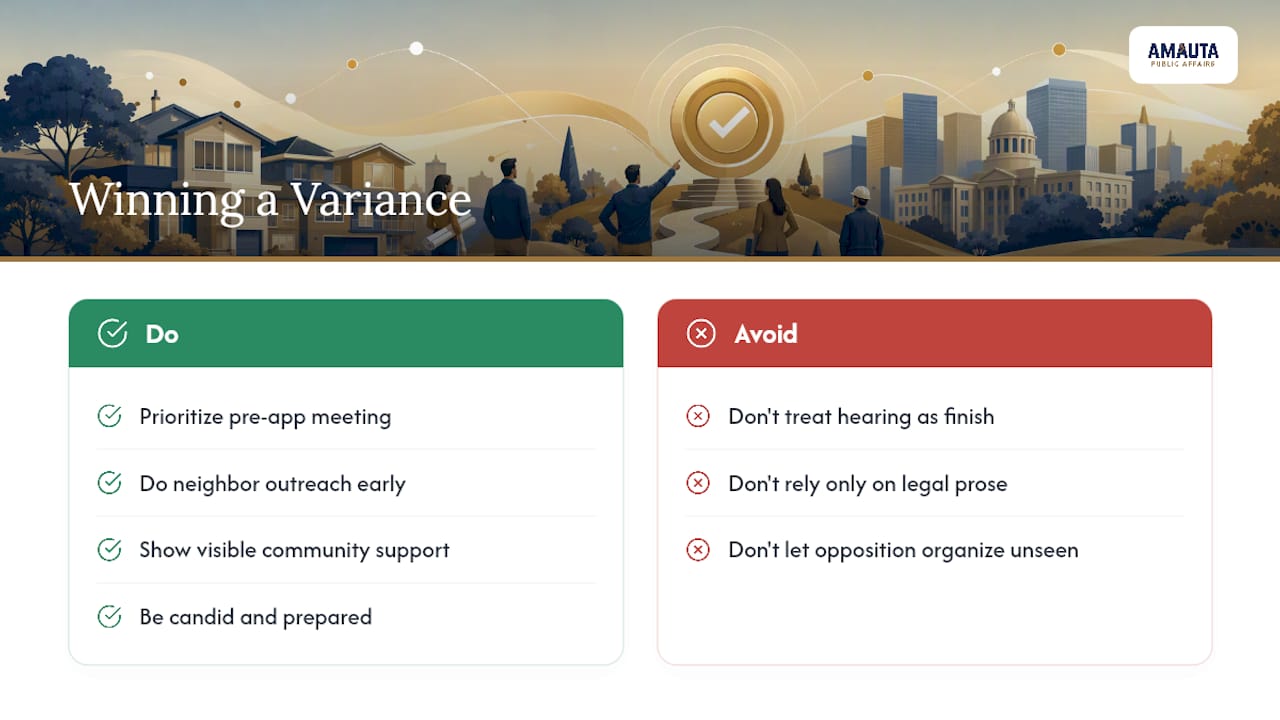
The conventional advice, hire an attorney, file the paperwork, show up and present, isn’t wrong so much as incomplete. It treats a fundamentally political process as a purely legal one. Boards are made of people who respond to preparation, candor, and visible community buy-in, not just correct citations to the ordinance.
If you take one thing from this roadmap, prioritize the pre-application meeting and the neighbor outreach over polishing the hardship letter’s prose. A merely adequate legal argument delivered with real stakeholder support outperforms a brilliant one delivered cold, almost every time.
— Ignacio
Get Help Running Your Variance Approval Strategy
A hardship letter and a survey can satisfy a board’s statutory findings and still lose at the hearing if nobody managed the politics around it. That’s the gap Amautapublicaffairs closes: instead of treating your variance as a filing to submit and hope for, it’s run as a coordinated approval strategy from the pre-application meeting forward.
A typical engagement includes stakeholder mapping to identify which commissioners or neighborhood groups will decide the outcome, an approval risk assessment before you ever file, targeted community outreach and one-pagers built around your actual findings, and media relations support if the project is likely to draw public attention. Amautapublicaffairs works across land use, energy, and infrastructure projects nationwide, coordinating land management and permitting support alongside the community engagement work that determines whether a board hearing goes smoothly or turns into a fight.
If your project has a contested site, a prior denial, or a hearing already on the calendar, visit the Amautapublicaffairs services page and request a consultation before your next filing deadline.
Sources
Recommended
Comments