
What Does Environmental Public Affairs Mean?

Environmental public affairs is the strategic practice of influencing environmental policy, managing regulatory relations, and engaging communities to address ecological and land use challenges. The field applies core public affairs functions — government relations, policy strategy, and stakeholder engagement — specifically to environmental issues such as ecology, land use, and environmental regulation. Practitioners work at the intersection of science, law, and politics, translating technical environmental concerns into policy outcomes. Agencies like NOAA, frameworks like NEPA, and community engagement models like the IMT framework all shape how this discipline operates in practice.
What does environmental public affairs mean in practice?
Environmental public affairs is defined as the application of public affairs tools to environmental issues, with the goal of shaping policy outcomes and securing public support. The SAGE Handbook of Public Affairs identifies it as a specialized discipline managing government and stakeholder interactions within an ecological context. This definition of environmental affairs goes beyond simple communication. It encompasses regulatory engagement, coalition building, and the ongoing management of relationships between organizations, government bodies, and affected communities.
The field sits at a critical junction. Organizations pursuing land use approvals, energy projects, or conservation programs must navigate complex regulatory processes while maintaining credibility with the public. Environmental public affairs provides the framework for doing both simultaneously. Without it, even technically sound projects can stall due to community opposition or regulatory friction.

Understanding public affairs and environment together means recognizing that policy influence and community trust are not separate goals. They reinforce each other. A project that earns genuine community support moves through regulatory review with far less resistance than one that treats public engagement as a checkbox.
How does environmental public affairs differ from related roles?
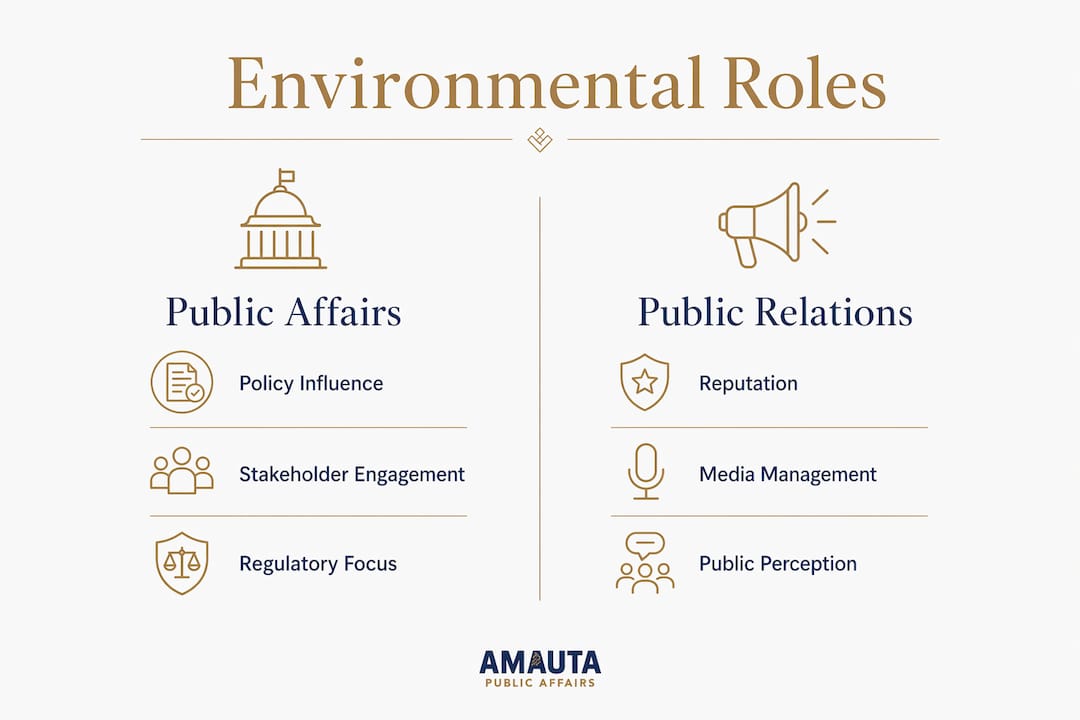
Environmental public affairs is distinct from environmental public relations and environmental policy analysis, though all three fields overlap. Clarifying these distinctions helps researchers and professionals choose the right approach for their work.
Environmental public relations focuses primarily on reputation management. Its core goal is shaping public perception of an organization’s environmental record. Environmental public affairs, by contrast, focuses on regulatory engagement and advocacy to influence policy outcomes and secure a social license to operate. PR manages the message; public affairs changes the rules.
Environmental policy analysis centers on research and policy development. Analysts evaluate regulatory proposals, model outcomes, and produce recommendations. Environmental public affairs practitioners use that analysis as a tool, but their primary work is stakeholder engagement, testimony, and coalition management. The analyst writes the brief; the public affairs professional delivers it to the right decision-maker at the right moment.
The table below summarizes the core distinctions:
Dimension | Environmental public affairs | Environmental public relations | Environmental policy analysis |
Primary goal | Policy influence and regulatory engagement | Reputation and public perception | Research and policy recommendations |
Core activities | Testimony, comment letters, coalition building | Media outreach, messaging, brand positioning | Data analysis, regulatory review, policy modeling |
Key relationships | Government officials, regulators, communities | Media, general public, investors | Policymakers, academic institutions, agencies |
Output | Regulatory outcomes, permits, community support | Press coverage, public sentiment | Policy briefs, impact assessments |
What is environmental advocacy within this framework? Advocacy is one tool inside the broader environmental public affairs toolkit. It includes formal actions like submitting public comment letters during NEPA scoping periods, testifying before regulatory bodies, and joining coalitions that advance shared policy positions. Advocacy is the visible tip of a much larger practice.
How does environmental public affairs shape land use decisions?
Land use decisions are among the most contested regulatory processes in the United States. Environmental public affairs shapes these decisions by structuring how communities, agencies, and project proponents interact throughout the review process.
NEPA scoping and public comment windows are the primary formal mechanisms. NOAA’s 2026 supplemental programmatic environmental impact statement for coral reef conservation illustrates how federal agencies use structured scoping processes to invite public and agency participation with specific objectives. Environmental public affairs practitioners prepare organizations to participate effectively in these windows, not just submit comments, but shape the framing of the issues under review.
The IMT community engagement framework shifts the model from transactional to partnership-based engagement. This means valuing frontline and Tribal community knowledge as genuine expertise, not just public opinion to be managed. That shift has direct implications for land use projects. Communities that feel heard produce fewer legal challenges and more durable project support.
Effective environmental public affairs in land use contexts relies on several practices:
Mapping all affected stakeholders before the formal comment period opens
Designing multilingual and accessible public meetings that lower participation barriers
Creating feedback loops where community input visibly changes project design
Maintaining ongoing dialogue rather than one-off public hearings
Documenting how public input was considered and communicating that back to participants
Pro Tip: Design your public engagement process so that participants can see how their input changed the project. Visible responsiveness is the single most effective trust-building mechanism in land use public affairs.
What strategies and tools do environmental public affairs practitioners use?
Environmental public affairs practitioners operate through a continuous cycle of policy monitoring, stakeholder mapping, and public input that feeds back into project design. This cycle is not linear. It runs in parallel with regulatory timelines and community dynamics.
The core practitioner toolkit includes:
Policy monitoring. Tracking legislative calendars, regulatory dockets, and agency announcements to identify windows for influence before decisions are finalized.
Stakeholder mapping. Identifying government officials, regulators, community organizations, and affected residents, then categorizing them by interest level and influence on the decision.
Relationship building. Establishing credibility with key decision-makers before a specific project requires their support. Cold outreach during a permit review is far less effective than a pre-existing relationship.
Advocacy through formal channels. Submitting comment letters and testimony during regulatory proceedings, joining coalitions with aligned organizations, and coordinating with legal counsel on regulatory strategy.
Environmental communication strategies. Developing messaging that connects project goals to community values, translating technical environmental data into accessible language for non-specialist audiences.
Feedback integration. Structuring public input processes so that community responses inform project modifications, creating a documented record of responsiveness for regulatory review.
The impact of public affairs on environment outcomes is most visible when these tools work together. A practitioner who monitors policy, maps stakeholders, builds relationships, and then advocates through formal channels creates compounding advantages. Each step reinforces the next.
Pro Tip: Start stakeholder mapping at least six months before any formal regulatory submission. The relationships you build before the clock starts are the ones that carry the most weight when decisions are made.
What challenges do environmental public affairs practitioners face?
Environmental issues are inherently contested. Policy change depends on framing environmental problems in ways that resonate with stakeholders’ underlying values, not just presenting scientific evidence. A solar project framed as economic development lands differently than the same project framed as habitat disruption. Both framings can be accurate. The practitioner’s job is to understand which framing dominates in a specific community and respond accordingly.
“The contested nature of environmental issues necessitates strategic alignment of engagement efforts with underlying social values.” — SAGE Publications
The risk of transactional engagement is significant. When organizations treat public meetings as compliance exercises rather than genuine dialogue, communities notice. Trust-based engagement reduces misinformation and increases the likelihood that environmental policies meet their targets. Transactional engagement produces the opposite: organized opposition, legal challenges, and project delays that cost far more than genuine participation would have.
The table below maps common challenges to proven responses:
Challenge | Strategic response |
Contested framing of environmental issues | Align messaging with community values through early listening sessions |
Low trust in project proponents | Adopt partnership-based engagement models; share decision-making power |
Misinformation in affected communities | Invest in accessible community education before formal comment periods |
Regulatory complexity | Combine legal counsel with public affairs expertise to navigate dual tracks |
Exclusion of frontline and Tribal voices | Integrate Tribal and frontline community knowledge as core expertise |
The IMT framework connects participation quality directly with higher success rates in decarbonization and land use programs. Organizations that invest in trust-based engagement from the start avoid the costly cycle of opposition, delay, and redesign.
Key takeaways
Environmental public affairs is the discipline that connects policy influence, regulatory engagement, and community trust into a single, integrated practice for addressing environmental and land use challenges.
Point | Details |
Core definition | Environmental public affairs applies government relations and stakeholder engagement tools to environmental and land use issues. |
Distinct from PR | Unlike environmental public relations, public affairs focuses on regulatory influence and policy outcomes, not reputation management. |
Land use application | NEPA scoping and public comment periods are primary arenas where environmental public affairs shapes project outcomes. |
Trust-based engagement | Partnership models that value frontline and Tribal knowledge produce more durable community support than transactional outreach. |
Practitioner cycle | Effective practice runs a continuous loop of policy monitoring, stakeholder mapping, advocacy, and feedback integration. |
Why the field matters more than most organizations realize
I have watched organizations spend months preparing technically perfect environmental impact assessments, only to see projects stall because no one built relationships with the communities most affected. The technical work is necessary. It is not sufficient.
What I find most underappreciated in this field is the distinction between participation and genuine engagement. Holding a public meeting satisfies a regulatory requirement. Designing a process where community members can see their input reflected in project changes builds the kind of trust that carries a project through opposition. These are not the same thing, and confusing them is the most common and costly mistake I see.
The shift toward trust-building frameworks in environmental public affairs is not a trend. It reflects a hard-won recognition that policy effectiveness depends on legitimacy, and legitimacy requires real participation. Organizations that treat community engagement as a pathway to implementation, rather than a box to check, consistently achieve better regulatory outcomes and face fewer legal challenges.
The field is also evolving in how it handles framing. Practitioners who understand the value dimensions behind environmental debates, not just the scientific ones, are far more effective at building coalitions and moving policy. That requires political literacy alongside technical knowledge. The organizations that develop both capabilities will define what environmental public affairs looks like in the next decade.
— Ignacio
How Amautapublicaffairs supports your environmental public affairs work
Amautapublicaffairs brings a campaign-style approach to the unique challenges of land use and environmental public affairs. The firm combines regulatory engagement expertise with community consultation and digital advocacy services to build genuine public support for complex projects.
For researchers, students, and professionals working on land use approvals, environmental permitting, or community consultation, Amautapublicaffairs offers tailored support across the full public affairs cycle. From stakeholder mapping to land management consulting, the firm’s methods are continuously refined based on real-time feedback to maximize project outcomes. Professionals ready to advance their environmental public affairs work can get connected with the Amautapublicaffairs team directly.
FAQ
What does environmental public affairs mean?
Environmental public affairs is the application of public affairs practices, including government relations, policy strategy, and stakeholder engagement, to environmental issues such as land use, ecology, and regulatory compliance.
How is environmental public affairs different from environmental PR?
Environmental public relations focuses on reputation and public perception, while environmental public affairs focuses on regulatory influence, policy advocacy, and securing a social license to operate.
What role does NEPA play in environmental public affairs?
NEPA scoping and public comment periods are structured processes where environmental public affairs practitioners engage agencies and communities to shape environmental impact assessments and project approvals.
What is environmental advocacy in this context?
Environmental advocacy refers to formal actions within the public affairs toolkit, including submitting comment letters, testifying before regulatory bodies, and building coalitions to advance shared environmental policy positions.
Why does community trust matter in environmental public affairs?
Trust-based engagement reduces misinformation and increases the likelihood that environmental programs meet their policy targets, as the IMT framework demonstrates through its partnership-based community engagement model.
Recommended
Comments